Tag: blogging

  • Kare Burosu at Wagamama, Silverburn

    Soundtrack to this post.
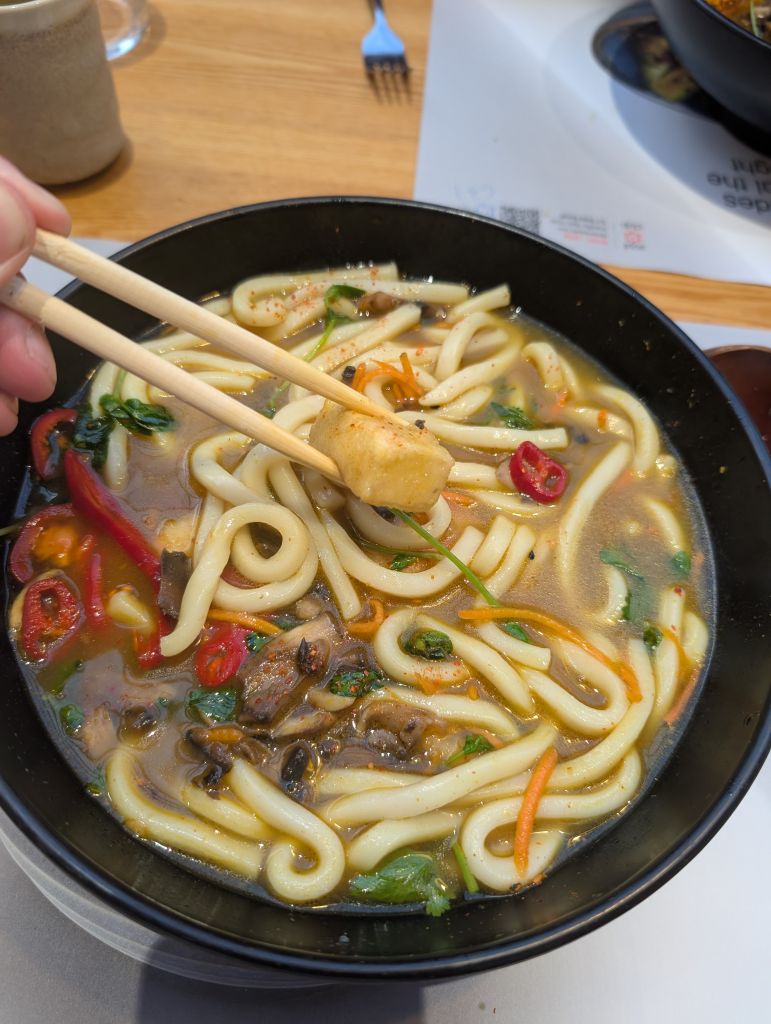
    A black bowl of Kare Burosu, thick udon noodles in a golden curry broth with mushrooms, red chillies, shredded carrot and coriander, with a piece of silken tofu held between chopsticks
    Lifting a piece of silken tofu out of the broth. Kare Burosu at Wagamama, Silverburn, Glasgow, July 2026.
    “Kare Burosu at Wagamama Silverburn” by Douglas Ireland, licensed CC BY 4.0.

    That is me lifting a piece of silken tofu out of a bowl of Kare Burosu at Wagamama in Silverburn, and yes, I am posting a picture of my tea on the internet.

    I do not have much in the way of social media. What I do have is this blog, and it turns out a blog does the job perfectly well. Anyone subscribed by RSS gets this popping up in their reader the same way a photo of somebody’s carbonara appears in a Facebook or Instagram feed. Same picture, same daft caption, no middleman.

    Owning the feed

    The difference is who is holding the steering wheel.

    On the proprietary platforms, you do not get a feed, you get a feed that has been arranged for you. The order is decided by an algorithm, the ads are slotted in between your pals, and the whole thing is tuned to keep you scrolling rather than to show you what you actually asked to see. If you follow somebody, there is no guarantee you will see their posts. If you post something, there is no guarantee your followers will see it.

    RSS is boring by comparison, and boring is the entire point. You subscribe to a site, you get everything that site publishes, in the order it was published, with nothing wedged in between. No ranking, no promoted posts, no “you might also like”. If you get sick of me you unsubscribe and I never find out, which is a much healthier arrangement than a follower count.

    The other bit that matters is the archive. Everything I write lives at my own domain, in files I control, on hosting I pay for. Platforms change their rules, get sold, get shut down, or quietly decide your account is no longer worth keeping. This post will still be here at the same address in ten years because the only person who can take it down is me. That is worth more than reach.

    So yep, this is my Instagram now. Get used to the food photos.

    The scran

    Kare Burosu is a lovely bit of cooking. Thick udon noodles in a golden curry broth, silken tofu, mushrooms, shredded carrot, coriander and a fair scattering of red chillies, and it is plant based from top to bottom. The broth is the star. It has that gentle coconut sweetness underneath and enough spice coming through to make you sit up.
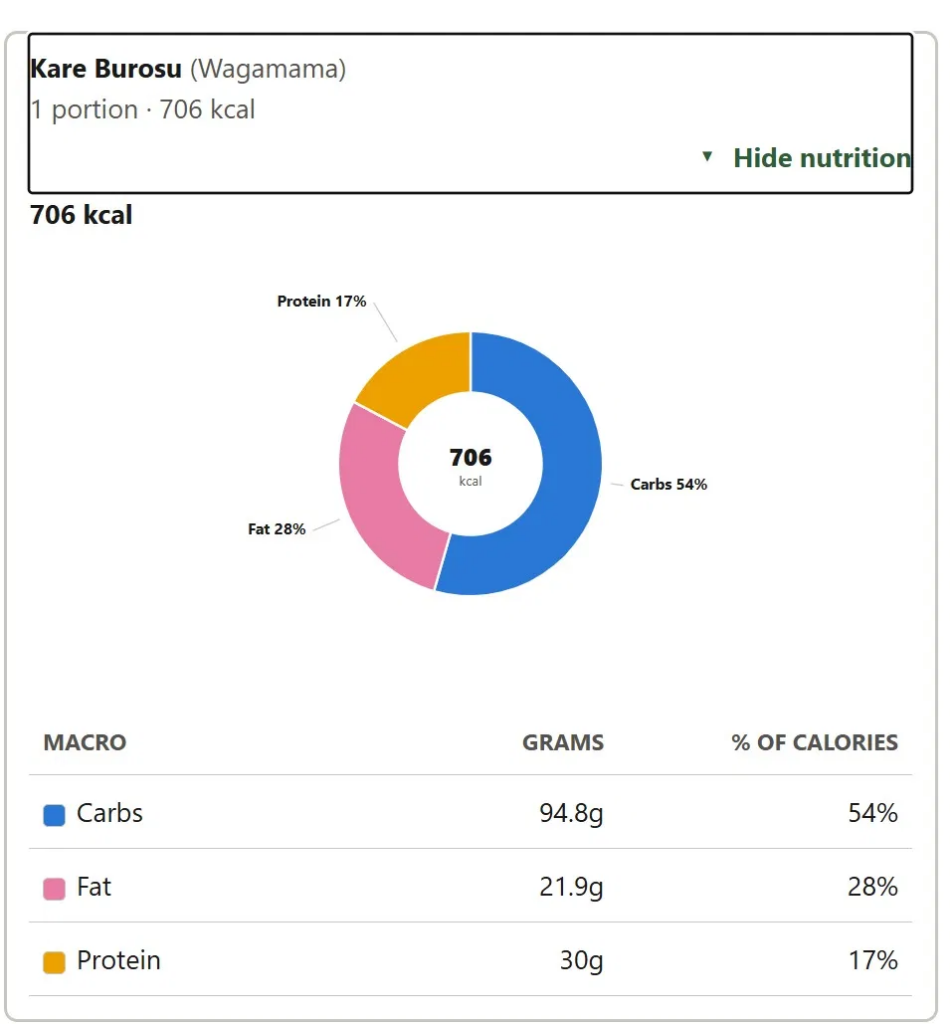
    Nutrition panel for one portion of Kare Burosu showing 706 kcal, with a doughnut chart splitting the calories into 54 per cent carbs, 28 per cent fat and 17 per cent protein, and a table listing 94.8g carbs, 21.9g fat and 30g protein
    The meal logged in Nourish, my own calorie counter. One portion, 706 kcal, 30g of plant based protein.
    “Kare Burosu logged in Nourish” by Douglas Ireland, licensed CC BY 4.0. Nutrition figures are Wagamama’s own published data.

    Regular readers will know I am a recovering food addict. I have written about that properly over in I’ll Start Tomorrow, so I will not go over the whole thing again here, but the short version is that eating out used to be a guessing game I would rather not play.

    This is where Wagamama deserve credit. Their website has the full nutrition for every dish on the menu, so I could sit down knowing exactly what I was ordering and log it properly afterwards in Nourish, my own calorie counter. 706 kcal, 30g of protein, and all of that protein plant based. Thirty grams from a bowl of noodles is not to be sniffed at.

    Restaurants that publish their numbers make life enormously easier for anyone who tracks what they eat, for whatever reason. It costs them nothing and it means people like me can order confidently instead of picking the safest looking thing on the menu and hoping.

    Double spicy

    Kare Burosu is Stephanie’s dish. She has been ordering it for years and she is the reason I had it at all, because I looked at the menu, remembered how good hers always smells, and asked for the same. These last couple of years she has taken to lifting the chillies out before she starts, and last night they came across into my bowl. Her broth ended up pitched where she likes it, mine ended up with double the heat, and we both got the dinner we wanted out of it.

    Reader, I loved it. Nose running, but I loved it.

    A great evening out, a great bowl of noodles, and a picture of it posted somewhere I actually own.
  • Excerpts From a Life

    Soundtrack to this post.

    I spent a few evenings this week doing the digital equivalent of clearing out the loft: going back through old blog posts that never had excerpts and finally writing them. Pure housekeeping. The kind of job you put off for a year because it’s boring, then put off for another year because now it’s boring and big.

    What I didn’t expect was to end up reading my own life back in fast-forward.

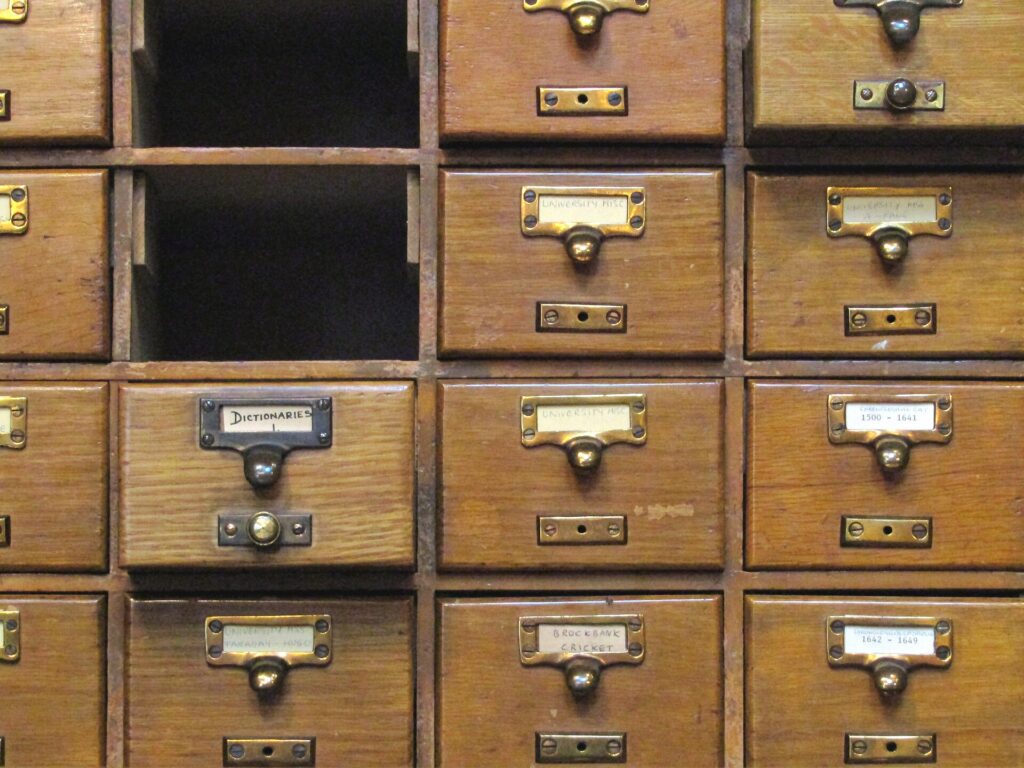
    Wooden drawers of a card catalogue at the John Rylands Library in Manchester.
    The card catalogue at the John Rylands Library in Manchester. An archive keeping score, one drawer at a time.
    Photo by Alicia Fagerving, via Wikimedia Commons, licensed under CC BY-SA 3.0

    When you publish a blog post, it’s just a post. A photo of two lattes in a Tim Hortons. A soup recipe. Monks singing John Lennon. A rant about the TV licence. A match report shouted at a telly in Paisley about a football club two hundred-odd miles away. Individually, half of them barely justify existing, and I nearly didn’t publish some of them at all.

    Read in one sitting, though, they stop being posts and start being threads.

    There’s the running thread: a torn disc and four nights in hospital, the slow shuffle back to the gym, “showing up feels like enough”, Couch to 5K finished and then abandoned, twice. Then a January on Ward 27, an MS diagnosis, one too many “I’ll start tomorrow”s, and now a year-long training plan with next summer’s Paisley 10K written at the end of it. I haven’t crossed that finish line yet. But reading the thread back, it turns out I’ve been running towards it, on and off, for years. The archive was keeping score before I’d even set the goal.

    That January stay deserves a mention of its own, actually. One hospital admission produced half a dozen posts: the case for independence, a reflex game built at 3 AM, the surveillance economics of a supermarket loyalty card, the view from the window of Ward 27. You can put me in a bed, apparently, but you can’t make me stop typing.

    There’s the politics thread: leaving one party for another, the Coronation I lasted three minutes of, Reform creeping up the ballot papers, and the case for Scottish independence made from every angle I could find, including flat on my back in an NHS bed.

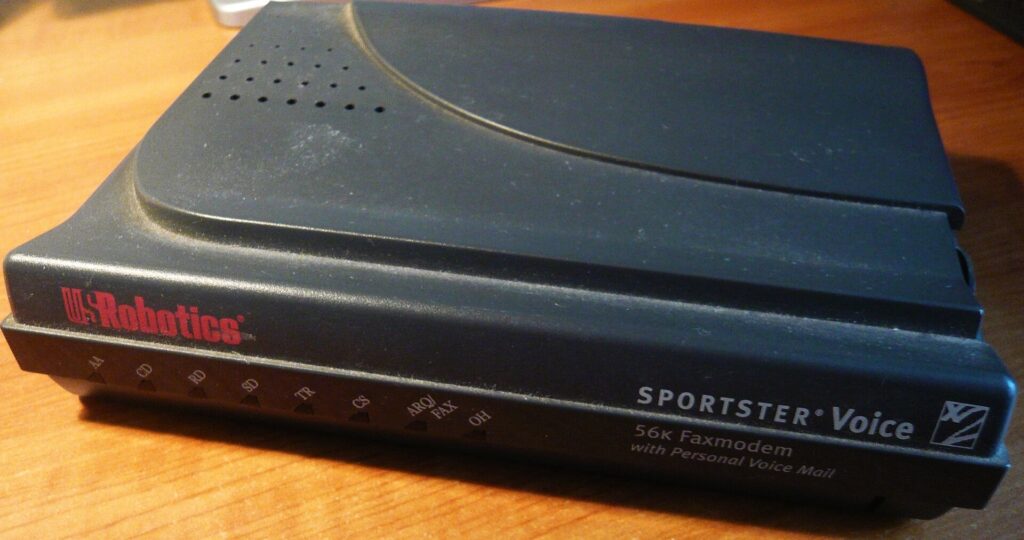
    And there’s the web thread, the longest of the lot: a kid getting online in 1994 to the sound of a screaming modem, then decades later moving his whole digital life onto a little server he controls, building his own search engine, and still, somehow, blogging.

    A beige US Robotics 56K external dial-up modem viewed from the front, with a row of status lights.
    A US Robotics 56K modem. If you know the noise, you’re already hearing it.
    Photo by Xiaowei, via Wikimedia Commons, licensed under CC BY 3.0

    None of it was planned. Nobody sits down and decides “I shall now document my recovery arc”. You just write about whatever’s in front of you, and years later the archive quietly turns out to have been telling a story.

    That, I think, is the best argument for owning your own site, and I’ve never quite managed to articulate it before. On the platforms, the feed only cares about your latest post. Everything older effectively evaporates, sorted into oblivion by an algorithm with no interest in who you were in 2017. Here, nothing evaporates. The version of me who lost a fantasy £100 a bet on the 2017 general election is still on this site, being confidently wrong, forever. That’s not embarrassing. That’s the point.

    And somewhere in the recent posts there’ll be a thread just starting that I can’t see yet. That’s the other thing about archives: you only spot the threads from the far end.

    So here’s a small suggestion, if you have a blog: read your archive, oldest first. And if you don’t have one, consider this your sign to start. Not for the audience. For the archive. Future you will want the receipts.

    (And yes, this post has an excerpt. I’m a changed man.)

  • Why I’m Using Bluesky (Yes, I’m Still Blogging Too)

    Soundtrack to this post.

    For a few years now I’ve leaned into the idea of using my own site, writing slowly, valuing analog habits, stepping back from the endless scroll. Blogging felt like a quiet resistance to the noise of “platform social media”. So when I say I’m now using Bluesky, it might sound like a contradiction. But for me it isn’t. Here’s why.

    Ownership & Control

    I blog because I want control over what I say, when I say it, and how it is archived. Relying on platforms where rules shift, algorithms change, and data disappears makes me uneasy.

    Bluesky is built on an open protocol (the AT Protocol) which means it’s designed with data portability, user agency, and less corporate lock-in in mind. (Decrypt)
    In other words: if I decide Bluesky isn’t for me, I won’t lose everything I built. That fits with how I try to live: make low-regret choices, keep options open.

    Bluesky logo.svg
    Image: Bluesky logo, public domain via Wikimedia Commons.

    Quiet in the Noise

    I’ve written about resisting modern pressures, choosing slow movement, real life over performance. A social feed that feels frantic, algorithmically driven, purely growth-oriented is the opposite of that.

    Bluesky offers a different vibe: transparency about algorithms, ability to pick or customise feeds rather than being forced into a “for you” feed that is opaque. (Rival IQ)
    This means I can dip in, say something, connect with people without feeling like I’m on a hamster wheel of engagement, likes, and noise.

    Community, Not Consumption

    I believe in small acts of defiance: keeping a capsule wardrobe, being intentional about my media, using the tools but not being used by them. Bluesky, for me, feels more like a place where that is possible.

    There’s a sense of early-stage community, of people who are there by choice, not because they got sucked in by algorithmic loops. Some early analysis shows the platform has higher levels of original content and less resharing or viral churn than many alternatives. (arXiv)
    That quieter, more intentional energy is something I’ve been missing elsewhere online.

    A Bridge, Not a Full Shift

    Using Bluesky doesn’t mean I’m giving up my blog. Far from it. I still want long-form, considered writing, a place I can archive my thoughts, reflect on slow change, recovery, the everyday in a way that social media rarely allows.

    But I’m also okay saying: yes, I will use a social platform. Because I believe we can use tools in ways aligned with our values, rather than be wholly subject to them.
    If used thoughtfully, Bluesky becomes a space for connection, not consumption.

    If You’d Like to Connect

    If you’re on Bluesky too, you’ll find me at @douglasireland.com.
    Feel free to follow, say hi, or simply observe how this plays out. No pressure, no algorithmic rabbit hole.

    I’m using Bluesky because it aligns with many of the things I’ve been saying here, small acts of intention, resisting the noise, owning my presence.
    And yes, I’m still blogging. Because some things are worth doing in their own time, on their own terms.

  • Like Shit Off a Shovel

    Soundtrack to this post.

    I first got online in 1994. Back then, just saying that felt futuristic. Most people I knew didn’t have the internet at all. You had to dial in, literally. That high-pitched screech of a modem connecting was the sound of something new.

    We called it the information superhighway, and it really did feel like that, a strange and open road with no clear destination. You just explored.

    The web was small. Pages were mostly grey. Text was blue and underlined. If you wanted a picture, it took time to load. Search engines weren’t very good. But there was something honest about it. You were more likely to stumble upon someone’s handmade website or message board than be guided by an algorithm. It felt like wandering.

    I remember someone in my family trying my 28.8k modem for the first time. After watching a page load faster than expected, they leaned back and said, “That thing goes like shit off a shovel.” At the time, it really did feel like that.

    I spent time on Usenet newsgroups, where people held long, often thoughtful discussions, threaded and searchable. And I used IRC, where you could drop into a channel and chat in real time with strangers from around the world. There was something raw but real about it. No profiles. No bios. Just usernames and conversation.

    There was no social media, no feeds, no notifications. If you wanted to connect with someone, you’d read their post or their homepage and send them an email. Maybe they’d write back. It was slow in the best way.

    Now the internet is always on, always loud. Every platform wants your attention. Content is chopped into algorithms and pushed into your day whether you asked for it or not. People compete for visibility, likes, reach. It’s not all bad, but it’s a long way from how it started.

    I’ve been thinking about that a lot lately. About how the internet used to be made up of small, personal spaces. And how it could be that again, at least in a quiet corner.

    That’s what I’m trying to build here. This site doesn’t run on likes or shares. I don’t have to post at the right time or follow trends. I just write when I want to. People can leave a comment if they feel like it. Or not.

    The difference is, I control this space. No ads. No feeds. Just a small corner of the internet where I can show up as myself.

    It might seem old-fashioned, but I don’t mind that. I’m from the dial-up days. And I still think there’s something worth keeping from that time.

    At the same time, I’m not anti-technology. Quite the opposite. I still get excited about new ideas and tools, especially AI. I think we’re only just beginning to see how it’s going to change how we work, create, communicate and learn. Used well, it can help us cut through noise, automate the boring stuff, and make space for more human connection, not less.

    So I’m not turning my back on the future. I just want to bring a little more of the past into it.