Tag: Plant Based

  • Kare Burosu at Wagamama, Silverburn

    Soundtrack to this post.

    A black bowl of Kare Burosu, thick udon noodles in a golden curry broth with mushrooms, red chillies, shredded carrot and coriander, with a piece of silken tofu held between chopsticks
    Lifting a piece of silken tofu out of the broth. Kare Burosu at Wagamama, Silverburn, Glasgow, July 2026.
    “Kare Burosu at Wagamama Silverburn” by Douglas Ireland, licensed CC BY 4.0.

    That is me lifting a piece of silken tofu out of a bowl of Kare Burosu at Wagamama in Silverburn, and yes, I am posting a picture of my tea on the internet.

    I do not have much in the way of social media. What I do have is this blog, and it turns out a blog does the job perfectly well. Anyone subscribed by RSS gets this popping up in their reader the same way a photo of somebody’s carbonara appears in a Facebook or Instagram feed. Same picture, same daft caption, no middleman.

    Owning the feed

    The difference is who is holding the steering wheel.

    On the proprietary platforms, you do not get a feed, you get a feed that has been arranged for you. The order is decided by an algorithm, the ads are slotted in between your pals, and the whole thing is tuned to keep you scrolling rather than to show you what you actually asked to see. If you follow somebody, there is no guarantee you will see their posts. If you post something, there is no guarantee your followers will see it.

    RSS is boring by comparison, and boring is the entire point. You subscribe to a site, you get everything that site publishes, in the order it was published, with nothing wedged in between. No ranking, no promoted posts, no “you might also like”. If you get sick of me you unsubscribe and I never find out, which is a much healthier arrangement than a follower count.

    The other bit that matters is the archive. Everything I write lives at my own domain, in files I control, on hosting I pay for. Platforms change their rules, get sold, get shut down, or quietly decide your account is no longer worth keeping. This post will still be here at the same address in ten years because the only person who can take it down is me. That is worth more than reach.

    So yep, this is my Instagram now. Get used to the food photos.

    The scran

    Kare Burosu is a lovely bit of cooking. Thick udon noodles in a golden curry broth, silken tofu, mushrooms, shredded carrot, coriander and a fair scattering of red chillies, and it is plant based from top to bottom. The broth is the star. It has that gentle coconut sweetness underneath and enough spice coming through to make you sit up.
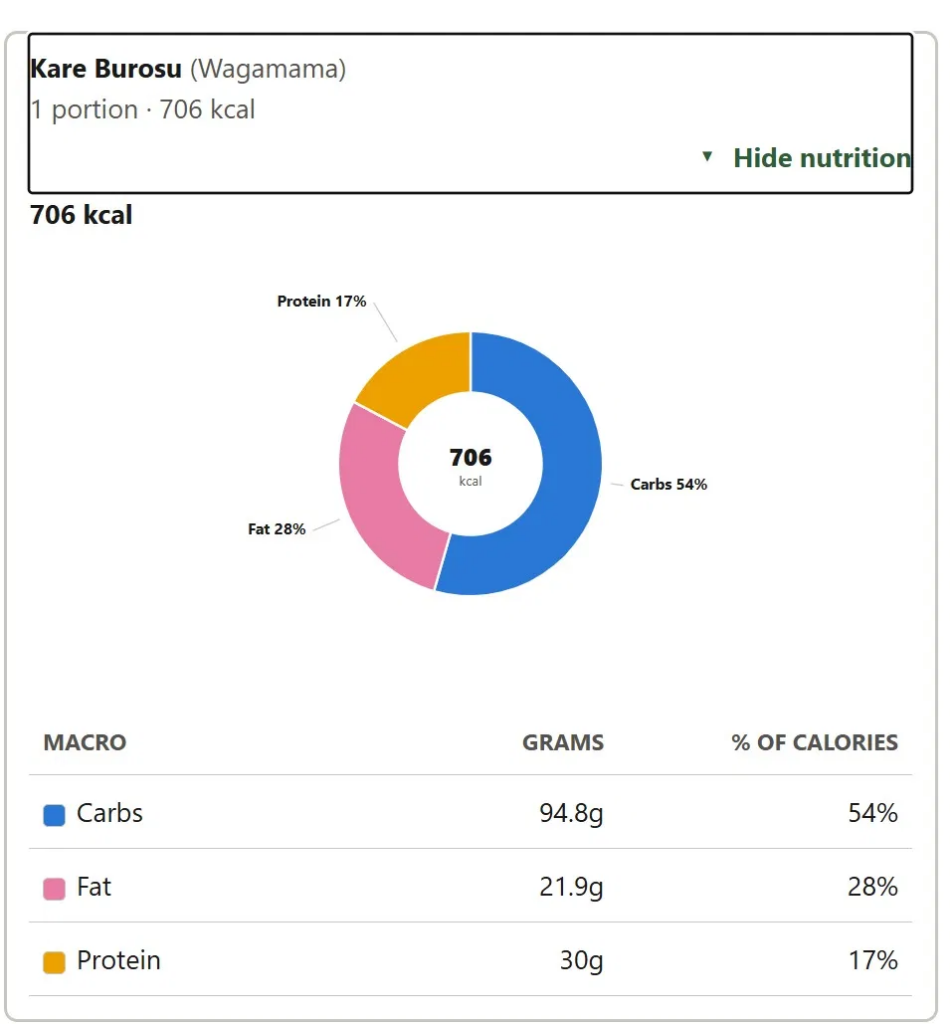
    Nutrition panel for one portion of Kare Burosu showing 706 kcal, with a doughnut chart splitting the calories into 54 per cent carbs, 28 per cent fat and 17 per cent protein, and a table listing 94.8g carbs, 21.9g fat and 30g protein
    The meal logged in Nourish, my own calorie counter. One portion, 706 kcal, 30g of plant based protein.
    “Kare Burosu logged in Nourish” by Douglas Ireland, licensed CC BY 4.0. Nutrition figures are Wagamama’s own published data.

    Regular readers will know I am a recovering food addict. I have written about that properly over in I’ll Start Tomorrow, so I will not go over the whole thing again here, but the short version is that eating out used to be a guessing game I would rather not play.

    This is where Wagamama deserve credit. Their website has the full nutrition for every dish on the menu, so I could sit down knowing exactly what I was ordering and log it properly afterwards in Nourish, my own calorie counter. 706 kcal, 30g of protein, and all of that protein plant based. Thirty grams from a bowl of noodles is not to be sniffed at.

    Restaurants that publish their numbers make life enormously easier for anyone who tracks what they eat, for whatever reason. It costs them nothing and it means people like me can order confidently instead of picking the safest looking thing on the menu and hoping.

    Double spicy

    Kare Burosu is Stephanie’s dish. She has been ordering it for years and she is the reason I had it at all, because I looked at the menu, remembered how good hers always smells, and asked for the same. These last couple of years she has taken to lifting the chillies out before she starts, and last night they came across into my bowl. Her broth ended up pitched where she likes it, mine ended up with double the heat, and we both got the dinner we wanted out of it.

    Reader, I loved it. Nose running, but I loved it.

    A great evening out, a great bowl of noodles, and a picture of it posted somewhere I actually own.
  • Stop the Presses: Supreme Court Rules Consumers Apparently Confused by Oats

    Soundtrack to this post.

    If you thought common sense was making a comeback in 2026, I have some bad news for you.

    Today, the UK Supreme Court handed down a final verdict in the long-running, and frankly exhausting, battle between Swedish oat drink maker Oatly and the powerful dairy lobby, Dairy UK. The unanimous ruling is that Oatly has lost the right to trademark their slogan “Post Milk Generation” for their food and drink products.

    Why? Because apparently, the highest court in the land agrees with the dairy industry that the word “milk” is far too confusing for us mere mortals to handle unless it comes directly from an animal’s udder.

    The legal basis for this decision rests on the idea that using “milk” terminology for plant-based products is misleading. The Justices argued that the phrase “Post Milk Generation” did not clearly describe the product’s characteristic (i.e. being dairy-free) and might leave poor, bewildered shoppers wondering if the carton contained no milk or just a little bit of milk.

    I’m sorry, but do they take us for idiots?

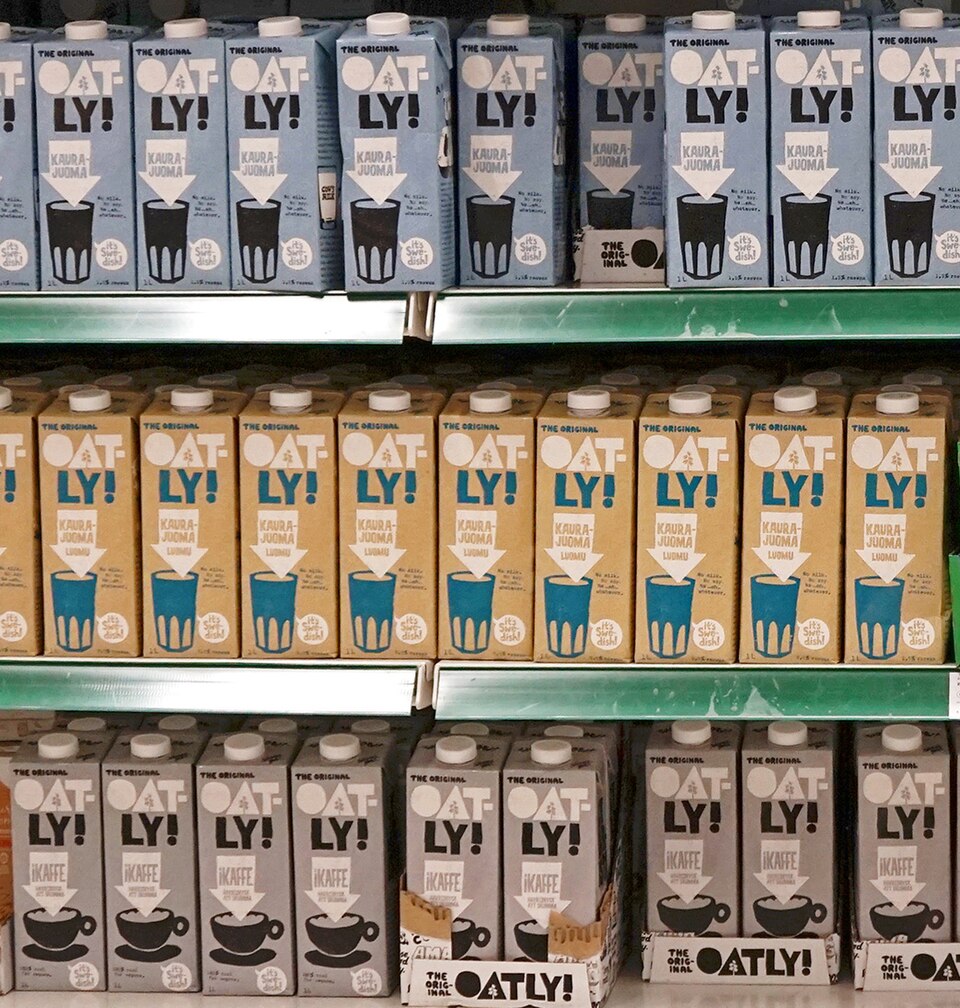
    A variety of Oatly's oat-based drinks on a supermarket shelf.
    A variety of Oatly’s oat-based drinks on a supermarket shelf. The UK Supreme Court has ruled that the company cannot use the word “milk” to describe these plant-based alternatives. Image: Tiia Monto, CC BY-SA 3.0, via Wikimedia Commons

    This ruling is a victory for pedantry over reality. It is a desperate cling to outdated definitions championed by an industry terrified of changing consumer habits.

    Let’s apply this “confusion” logic elsewhere in the supermarket aisle, shall we?

    When I buy fish fingers, I am fully aware that I am not purchasing actual anatomical digits harvested from cod.

    When I buy baby oil, I do not assume it is made from babies.

    When someone buys a veggie burger, nobody, and I mean nobody, is distressed to find a lack of ground beef inside.

    We know that oat milk is squeezed from oats. We know almond milk comes from almonds. We get it. The only people who seem “confused” are the lobbyists running Dairy UK and the lawyers arguing these semantics.

    Oatly’s response hit the nail on the head. Bryan Carroll, their UK general manager, called this what it is: a move to “stifle competition” that “solely benefits Big Dairy.”

    We are living in a time where shifting toward more plant-based diets is crucial for ethical and environmental sustainability. We need to be encouraging these swaps, making them accessible and appealing. Instead, we are wasting years and untold amounts of money in court debating whether the word “milk” can be used to describe a creamy, white liquid that you put on your cereal, just because it didn’t involve a cow.

    The dairy industry is fighting a losing battle against cultural shifts. Trying to fence off common language through legal action will not stop people from choosing sustainable alternatives. It just makes the industry look petty and out of touch.

    The courts might say we are not a “Post Milk Generation” yet, but the consumers already know where the future lies, regardless of what the label is allowed to say.