Tag: reflection

  • Excerpts From a Life

    Soundtrack to this post.

    I spent a few evenings this week doing the digital equivalent of clearing out the loft: going back through old blog posts that never had excerpts and finally writing them. Pure housekeeping. The kind of job you put off for a year because it’s boring, then put off for another year because now it’s boring and big.

    What I didn’t expect was to end up reading my own life back in fast-forward.

    Wooden drawers of a card catalogue at the John Rylands Library in Manchester.
    The card catalogue at the John Rylands Library in Manchester. An archive keeping score, one drawer at a time.
    Photo by Alicia Fagerving, via Wikimedia Commons, licensed under CC BY-SA 3.0

    When you publish a blog post, it’s just a post. A photo of two lattes in a Tim Hortons. A soup recipe. Monks singing John Lennon. A rant about the TV licence. A match report shouted at a telly in Paisley about a football club two hundred-odd miles away. Individually, half of them barely justify existing, and I nearly didn’t publish some of them at all.

    Read in one sitting, though, they stop being posts and start being threads.

    There’s the running thread: a torn disc and four nights in hospital, the slow shuffle back to the gym, “showing up feels like enough”, Couch to 5K finished and then abandoned, twice. Then a January on Ward 27, an MS diagnosis, one too many “I’ll start tomorrow”s, and now a year-long training plan with next summer’s Paisley 10K written at the end of it. I haven’t crossed that finish line yet. But reading the thread back, it turns out I’ve been running towards it, on and off, for years. The archive was keeping score before I’d even set the goal.

    That January stay deserves a mention of its own, actually. One hospital admission produced half a dozen posts: the case for independence, a reflex game built at 3 AM, the surveillance economics of a supermarket loyalty card, the view from the window of Ward 27. You can put me in a bed, apparently, but you can’t make me stop typing.

    There’s the politics thread: leaving one party for another, the Coronation I lasted three minutes of, Reform creeping up the ballot papers, and the case for Scottish independence made from every angle I could find, including flat on my back in an NHS bed.

    And there’s the web thread, the longest of the lot: a kid getting online in 1994 to the sound of a screaming modem, then decades later moving his whole digital life onto a little server he controls, building his own search engine, and still, somehow, blogging.
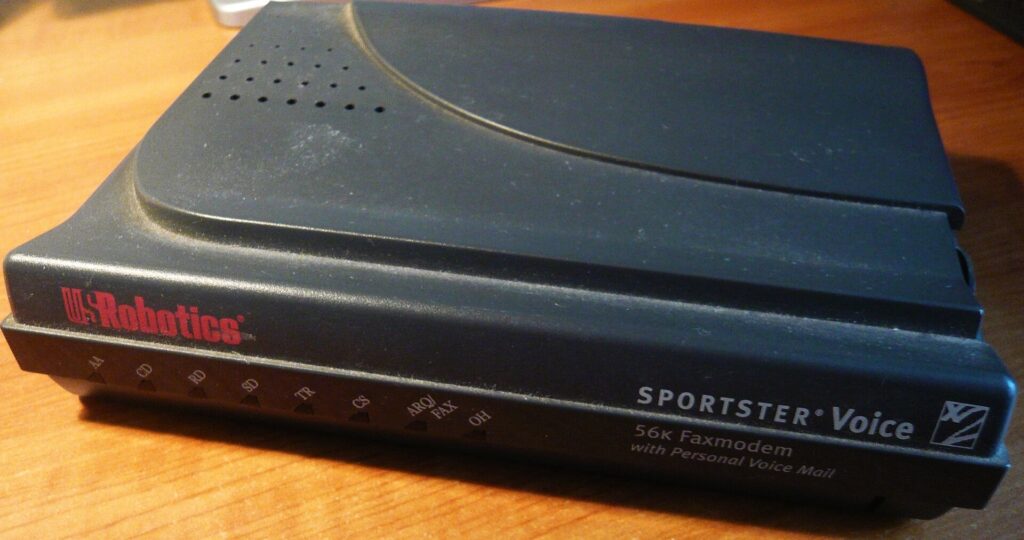
    A beige US Robotics 56K external dial-up modem viewed from the front, with a row of status lights.
    A US Robotics 56K modem. If you know the noise, you’re already hearing it.
    Photo by Xiaowei, via Wikimedia Commons, licensed under CC BY 3.0

    None of it was planned. Nobody sits down and decides “I shall now document my recovery arc”. You just write about whatever’s in front of you, and years later the archive quietly turns out to have been telling a story.

    That, I think, is the best argument for owning your own site, and I’ve never quite managed to articulate it before. On the platforms, the feed only cares about your latest post. Everything older effectively evaporates, sorted into oblivion by an algorithm with no interest in who you were in 2017. Here, nothing evaporates. The version of me who lost a fantasy £100 a bet on the 2017 general election is still on this site, being confidently wrong, forever. That’s not embarrassing. That’s the point.

    And somewhere in the recent posts there’ll be a thread just starting that I can’t see yet. That’s the other thing about archives: you only spot the threads from the far end.

    So here’s a small suggestion, if you have a blog: read your archive, oldest first. And if you don’t have one, consider this your sign to start. Not for the audience. For the archive. Future you will want the receipts.

    (And yes, this post has an excerpt. I’m a changed man.)

  • It’s not about the flies

    Soundtrack to this post.

    I heard the old saying again the other day.
    You catch more flies with honey than with vinegar.

    It’s one of those phrases that feels too neat to be useful. But it’s stuck with me.

    I’ve tried vinegar.
    Sharp words. Cold silences.
    Avoiding people who rub me the wrong way.
    It doesn’t do much. You just end up bitter and still alone.

    Honey is harder.
    It takes more patience. You’ve got to swallow your pride. Smile when you don’t feel like it. Make the first move. Let things slide.

    But every so often, it works.
    Someone opens up.
    You get a second conversation instead of a dead end.
    And it feels better. Not in a smug, self-righteous way. Just… lighter.

    It doesn’t mean being fake. Or letting people treat you badly.
    Just choosing softness when the world’s offering you friction.

    Other sayings circle the same idea.
    A gentle word turns away wrath.
    Kill them with kindness.
    Politeness costs nothing.

    They’re not magic spells. But they shift the weight a bit. And most days, that’s enough.

  • Like Shit Off a Shovel

    Soundtrack to this post.

    I first got online in 1994. Back then, just saying that felt futuristic. Most people I knew didn’t have the internet at all. You had to dial in, literally. That high-pitched screech of a modem connecting was the sound of something new.

    We called it the information superhighway, and it really did feel like that, a strange and open road with no clear destination. You just explored.

    The web was small. Pages were mostly grey. Text was blue and underlined. If you wanted a picture, it took time to load. Search engines weren’t very good. But there was something honest about it. You were more likely to stumble upon someone’s handmade website or message board than be guided by an algorithm. It felt like wandering.

    I remember someone in my family trying my 28.8k modem for the first time. After watching a page load faster than expected, they leaned back and said, “That thing goes like shit off a shovel.” At the time, it really did feel like that.

    I spent time on Usenet newsgroups, where people held long, often thoughtful discussions, threaded and searchable. And I used IRC, where you could drop into a channel and chat in real time with strangers from around the world. There was something raw but real about it. No profiles. No bios. Just usernames and conversation.

    There was no social media, no feeds, no notifications. If you wanted to connect with someone, you’d read their post or their homepage and send them an email. Maybe they’d write back. It was slow in the best way.

    Now the internet is always on, always loud. Every platform wants your attention. Content is chopped into algorithms and pushed into your day whether you asked for it or not. People compete for visibility, likes, reach. It’s not all bad, but it’s a long way from how it started.

    I’ve been thinking about that a lot lately. About how the internet used to be made up of small, personal spaces. And how it could be that again, at least in a quiet corner.

    That’s what I’m trying to build here. This site doesn’t run on likes or shares. I don’t have to post at the right time or follow trends. I just write when I want to. People can leave a comment if they feel like it. Or not.

    The difference is, I control this space. No ads. No feeds. Just a small corner of the internet where I can show up as myself.

    It might seem old-fashioned, but I don’t mind that. I’m from the dial-up days. And I still think there’s something worth keeping from that time.

    At the same time, I’m not anti-technology. Quite the opposite. I still get excited about new ideas and tools, especially AI. I think we’re only just beginning to see how it’s going to change how we work, create, communicate and learn. Used well, it can help us cut through noise, automate the boring stuff, and make space for more human connection, not less.

    So I’m not turning my back on the future. I just want to bring a little more of the past into it.