Tag: running

  • The Race I Wasn’t Ready For (I Was Ready For)

    Soundtrack to this post.

    Who gets a cold in August? Me, apparently.

    Wednesday, three days out, I woke up with that first sniffle that you know is going somewhere bad. By Thursday I was fully snotty and sneezy, and Friday wasn’t much better. I very nearly pulled a sickie from work. Then it occurred to me that phoning in sick on Friday and then bragging about a 10K on Monday wasn’t a good look, so I persevered instead.

    I don’t get colds. I’ve always thought I had a strong immune system, right up until I got diagnosed with MS and started to wonder if that same immune system turning on itself was the reason I got MS in the first place. And the medication I take for it works by knocking back part of that immune system on purpose. So I looked it up, and it turns out that’s not just me being dramatic: picking up more colds is a known side effect of the drug. Which was a strange thing to make peace with three days before a race.

    Anyway. The cold had cleared by the time I woke up on Saturday morning. Lucky.
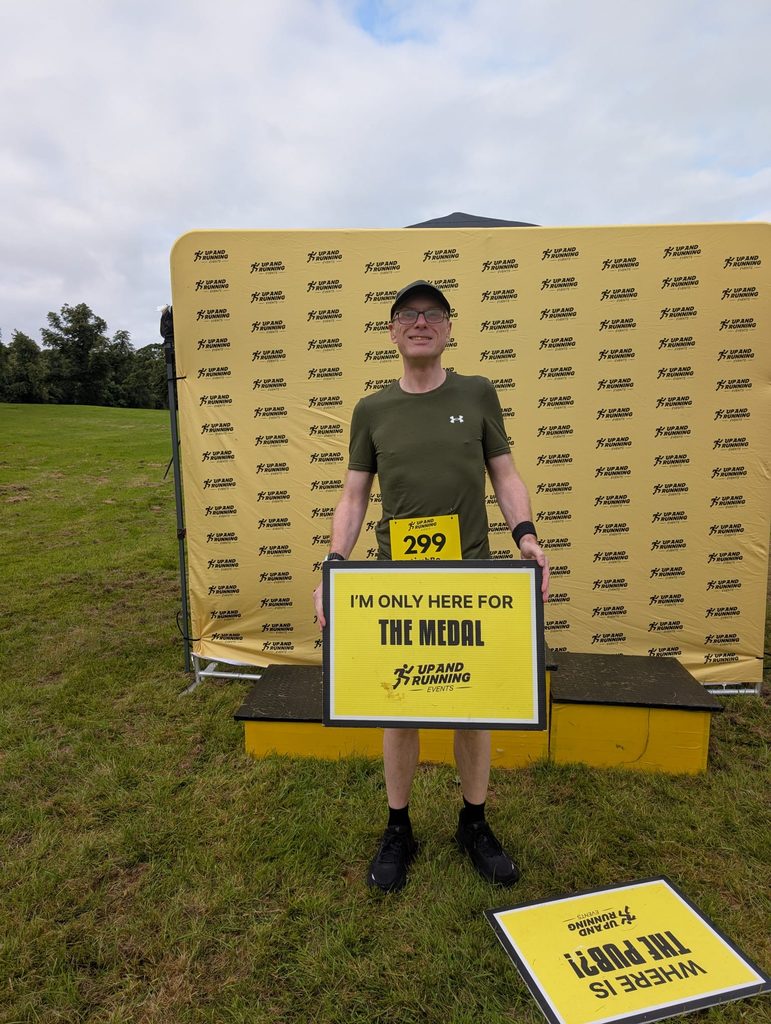
    Douglas standing in front of an Up and Running Events photo backdrop, holding a printed sign reading 'I'm only here for the medal'.
    Setting expectations early.

    I got to Bellahouston Park in good time, picked up my number, took the obligatory daft photo with the sign, and then had about forty minutes of standing around trying not to think about it too hard.
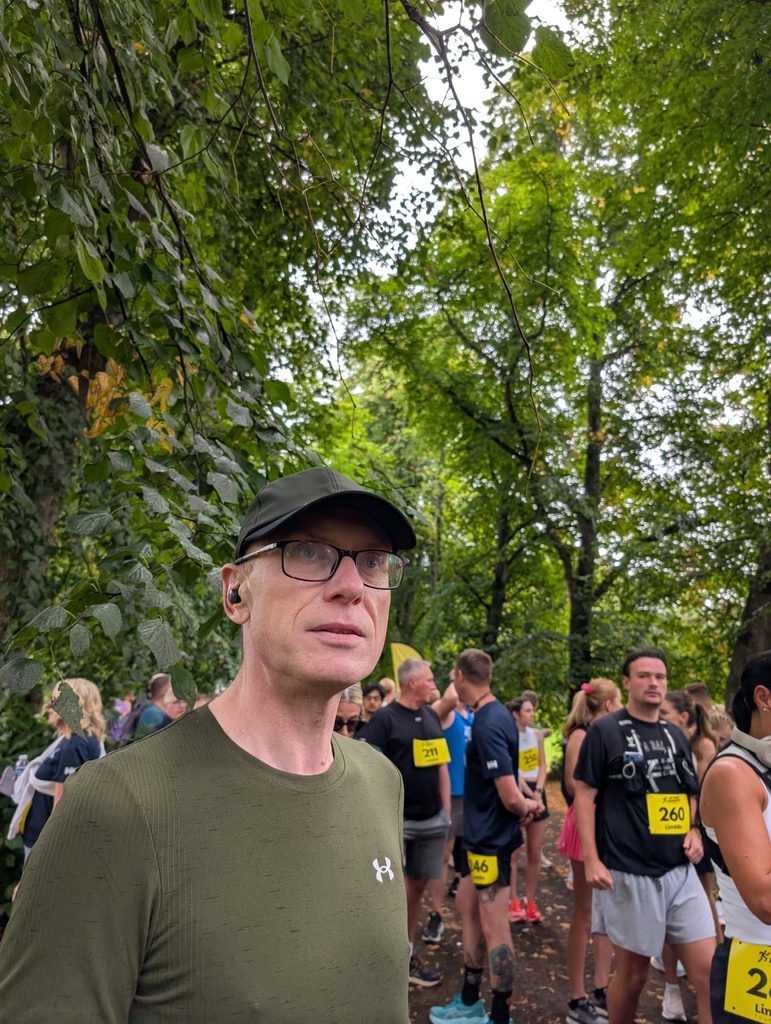
    Close-up of Douglas standing among other runners under trees at the start area, wearing a cap and glasses, looking slightly tense.
    One minute to go.

    I’ve written before about why I signed up for this one at all and how I built the plan to get round it: run nine minutes, walk one, repeat, and don’t chase anybody in the first kilometre. Two laps of the park. I knew the plan. I’d tested the plan all week. Standing at the start line a minute before the start, none of that made me feel any less nervous.

    The start came. I stuck to it. First lap felt exactly as easy as it was supposed to.
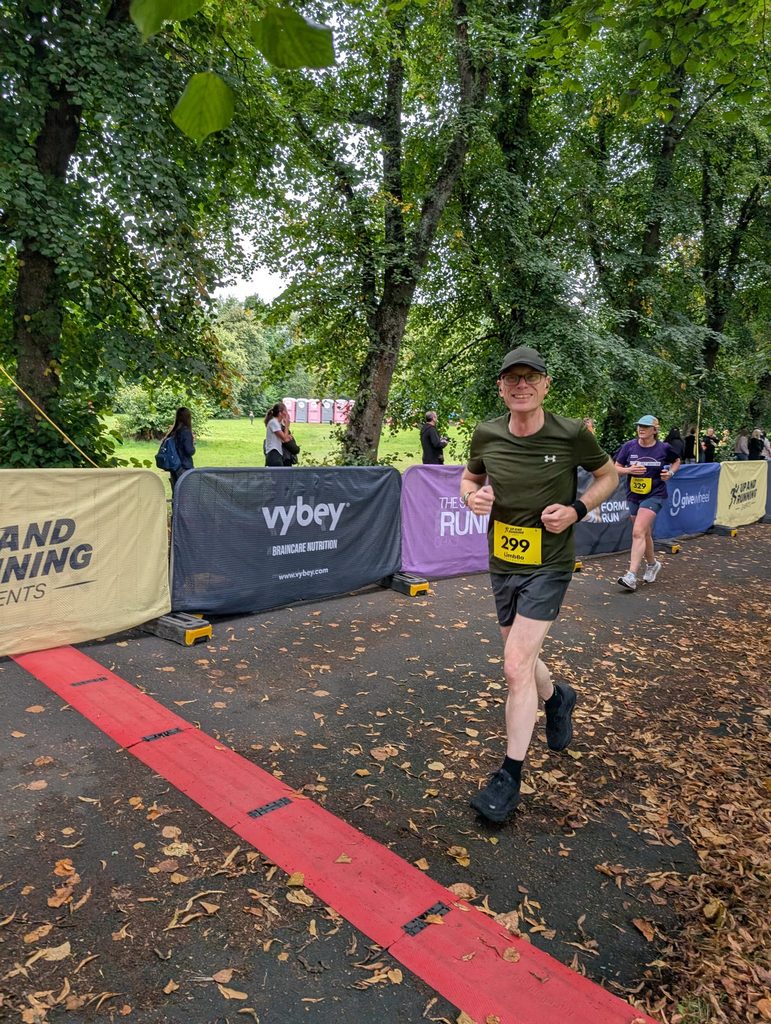
    Douglas running along a tree-lined park path, smiling, with race barriers and other runners visible behind him.
    Still enjoying myself at this point.

    Nobody warned me about the hill just after the start line. It’s nothing on lap one, legs fresh, you barely notice it’s there. On lap two, with five kilometres already in my legs, it was a different story entirely. That hill, second time round, was the closest I came to just stopping and walking the rest of the way in. I didn’t. I put my head down, shortened my stride, and got up it.
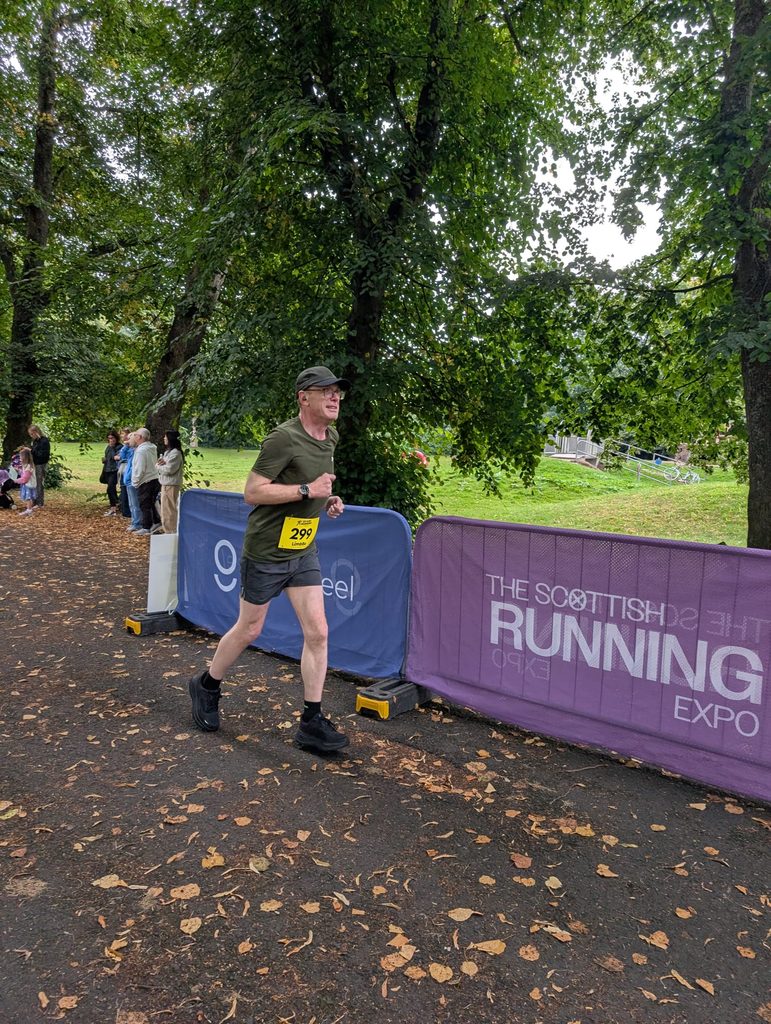
    Douglas running with a strained, focused expression along a leaf-covered path lined with event barriers.
    Pushing it, last stretch.

    After that it was just a case of holding on. The last kilometre or so I ran the whole thing in, no more walk breaks, because by that point stopping felt harder than not stopping.

    Bellahouston Park 10K 299
    Official finish time
    1:06:05
    chip timed
    Distance10 km
    Course2 laps
    Date22 Aug 2026
    VenueBellahouston Park, Glasgow
    Up and Running Events · Perfect Timing Scotland

    Official chip time: 1:06:05. My phone had me at 1:06:29, so somehow I ran faster than I thought I did, which has never happened to me before and may never happen again.
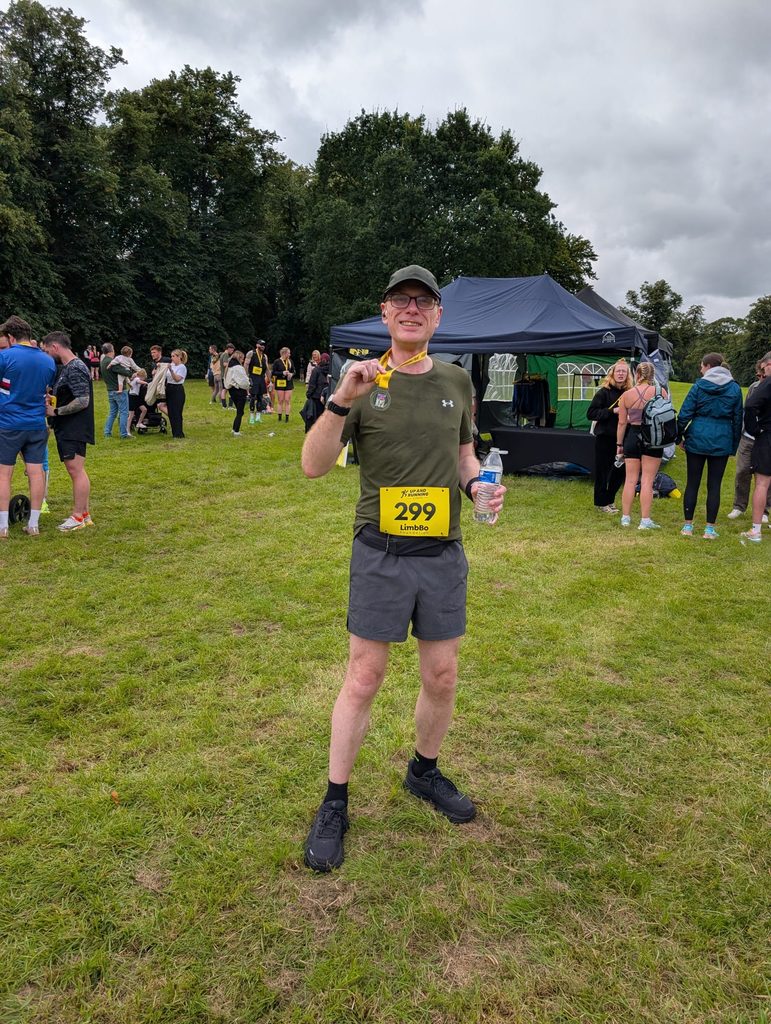
    Douglas standing on grass near the finish area, smiling and holding up his medal, with his race number still pinned on and a water bottle in his other hand.
    Well chuffed.

    None of this happens without Stephanie. This whole thing was her idea, not mine. I wasn’t sure about it when she first suggested it, if I’m honest, ten kilometres felt like a lot to sign up for off the back of nothing. She talked me into it anyway, and then she stood in the cold at the start line at half past nine on a Saturday morning to see me off, and was there again at the finish.
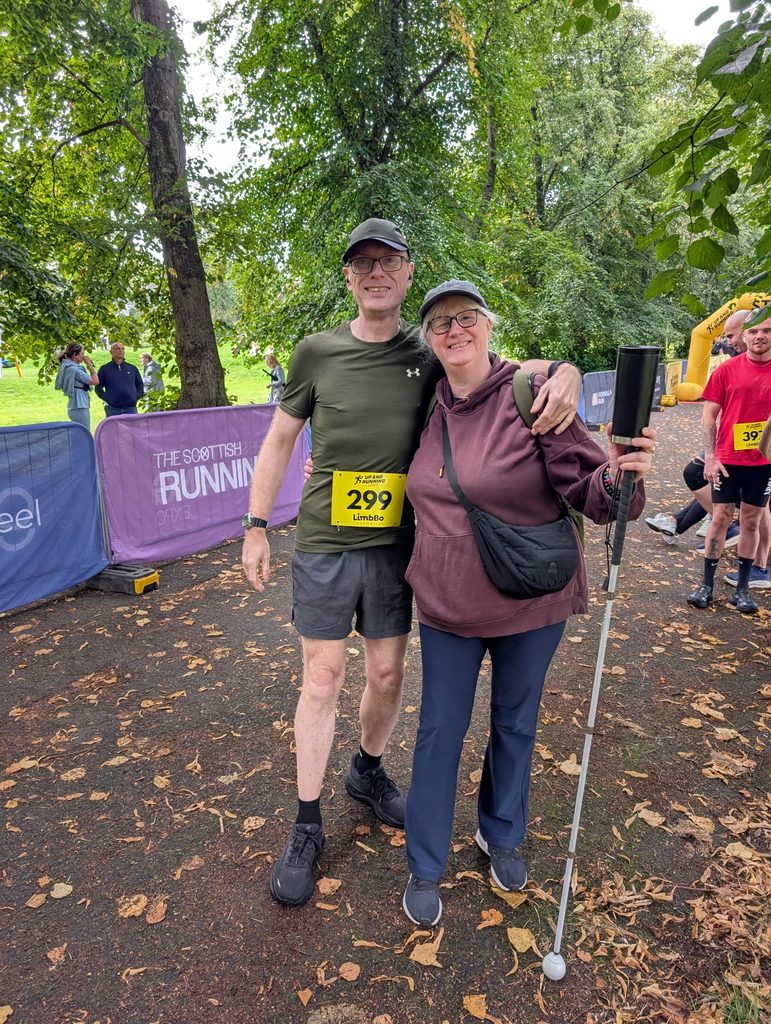
    Douglas in his running kit and race number with his arm around Stephanie, who is wearing a hoodie and holding a long cane, on the path near the start line.
    Waiting around at the start. She was cold even then.

    And here’s the thing: she’d picked up my cold off me the day before. So the woman who talked me into this stood outside in August, unwell, to cheer on someone who was only running because she’d talked him into it. I’m genuinely glad she pushed me into this, because I’d never have signed up for it on my own.
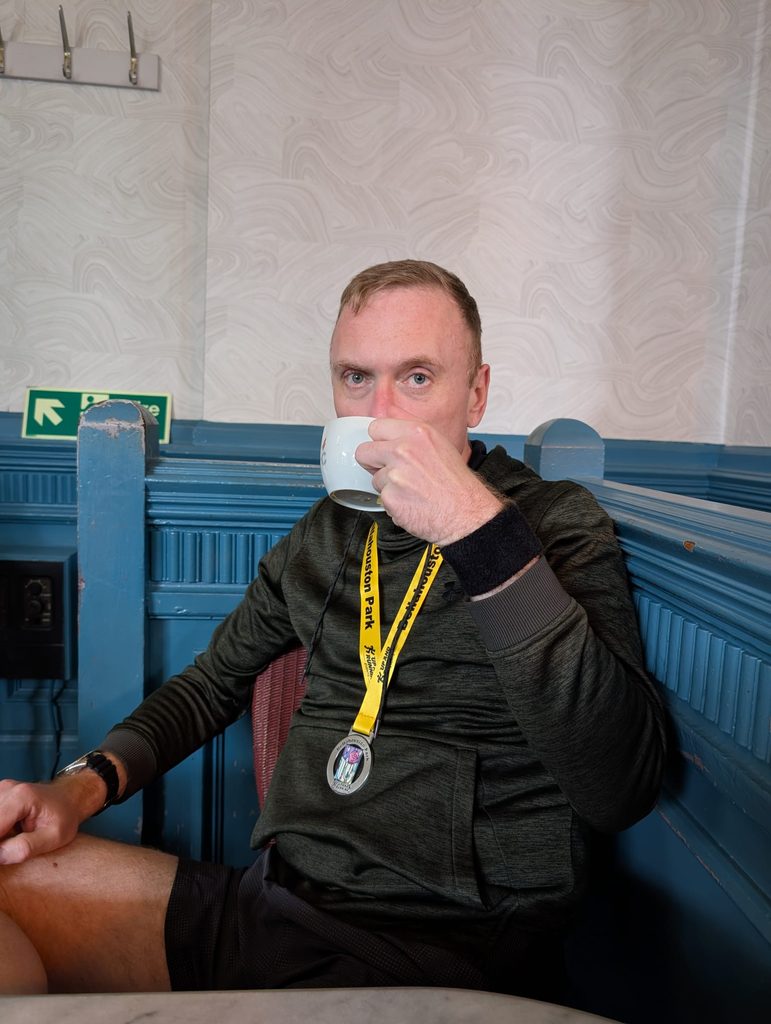
    Douglas sitting in a café booth drinking from a cup, still wearing his finisher's medal over a hoodie.
    Kept the medal on for the coffee. No regrets.

    Three months ago I couldn’t run for three minutes without stopping. Today I ran ten kilometres. Whatever comes next in the run-up to Paisley, I’ll take that.
  • Bellahouston 10K plan

    Soundtrack to this post.

    Race week Bellahouston Park 10K · Sat 22 Aug
    1. Sat 15 rest A walk if I fancy it.
    2. Sun 16 Long run, outdoors 40 to 45 min, 9 run / 1 walk. Roughly 6.5 to 7 km at about 7:00/km. The one session this week that changes anything.
    3. Mon 17 rest
    4. Tue 18 Easy 30 min Outdoors, same 9 / 1 rhythm. Keeping my legs turning over, nothing more.
    5. Wed 19 rest
    6. Thu 20 Shakeout, 20 min Very gentle. I cut it short or skip it if it feels like effort.
    7. Fri 21 rest Kit out, start time checked, water on.
    8. Sat 22 Bellahouston 10K Two laps of the park. First one should feel too easy.
    Pace band 9 run / 1 walk · target 70 min
    Clock Doing Roughly at
    0:00 to 9:00Run1.4 km
    9:00 to 10:00walk
    10:00 to 19:00Run2.9 km
    19:00 to 20:00walk
    20:00 to 29:00Run4.3 km
    29:00 to 30:00walk
    30:00 to 39:00Run5.8 km
    5K around 35:00
    39:00 to 40:00walk
    40:00 to 49:00Run7.2 km
    49:00 to 50:00walk
    50:00 to 59:00Run8.7 km
    59:00 to 60:00walk
    60:00 onwardsRun it in10 km
    I take the first walk break at 9 minutes even though I will not want to.
    I walk briskly. I do not stop, and I start running the second the minute is up.
    If 9 minutes feels long on the second lap, I drop to 5 run / 1 walk and keep going.
    If the phone fails no audio cues · course signs only
    1. 2km
    2. 4km
    3. 6km
    4. 8km
    I walk for one minute after each of these markers. Four breaks, read off the course signage.
    Two laps of the same 5 km loop, so the 6 km break is at the sign marked 1 km on my second lap, and the 8 km break is at the sign marked 3 km. Worth working out which physical signs those are before the start.
    A walk minute that runs to seventy seconds costs me nothing.
    Between breaks I run at whatever feels conversational.
    From the 8 km break I run the last 2 km all the way in.
  • A Race I’m Not Ready For

    Soundtrack to this post.

    I signed up for the Bellahouston Park 10K this evening, and I regretted it almost immediately.

    It wasn’t my idea. Stephanie talked me into it0, though I won’t pretend the bespoke finisher’s medal didn’t help. I’ve never had a running medal before, and there’s something almost embarrassing about how effective that turned out to be as an incentive.

    Her reasoning went something like this: I’m not going to run it in fifty minutes, or even an hour, so there’s no point going in with any real expectations. But that’s exactly what makes it useful. It’s a fixed point on the calendar, a number I can look back at in a year and measure everything else against. Not a race to win, just a race to have run.

    I’m seven weeks into Couch to 5K. Last week I ran my fastest ever Linwood parkrun, 29:15, a proper PB and comfortably inside the 30-minute 5K target I set myself. That’s the good news. The less good news is that Bellahouston Park is a 10K, on the 22nd of August, and I’ve still got two weeks of Couch to 5K left to run. The race lands right as I finish the programme, not after it.

    Couch to 5K Week 7
    • Day 1 completed
    • Day 2 completed
    • Day 3 completed
    WEEK 7 COMPLETE

    So the honest arithmetic looks like this: double a 29:15 5K and you get somewhere near 58 minutes for 10K, if pace held perfectly over double the distance, which it never does. Distance takes more out of you than a calculator thinks it will, and I’m still closer to the start of a training plan than the middle of one. An hour is not a sensible target for the 22nd of August. It might not even be a realistic one.

    But that’s sort of the point, and it’s why I said yes even while I was regretting it. This whole year is built around one number: a sub-50-minute Paisley 10K, twelve months from now. I’ve written before about starting that plan from a standing stop, and about the parkrun that turned into an unplanned checkpoint along the way. Bellahouston is the first time the plan has been tested against the actual distance rather than a fraction of it. It’s not a rehearsal I chose for myself. It got handed to me, earlier than I’d have picked, at a stage of training where I have no business expecting a good time.

    And that’s exactly why it’s a benchmark and not a race. A benchmark only tells you anything if the first reading is allowed to be a bit rough. If I waited until I felt ready to run a 10K, I’d never get a number down early enough for it to mean anything later. Stephanie’s version of that idea was kinder than mine, when I put it that way to her, she pushed back: “Yeah but can we make it a wee bit more positive? My thought process wasn’t that you were going to be fabulous, you have done really well but this is to see how far you will go.” She wasn’t wrong, and it’s a better way of putting it than mine was. The value isn’t in the time on the day. It’s in having a time at all, from this exact point in the plan, to set against whatever I run in the months after.

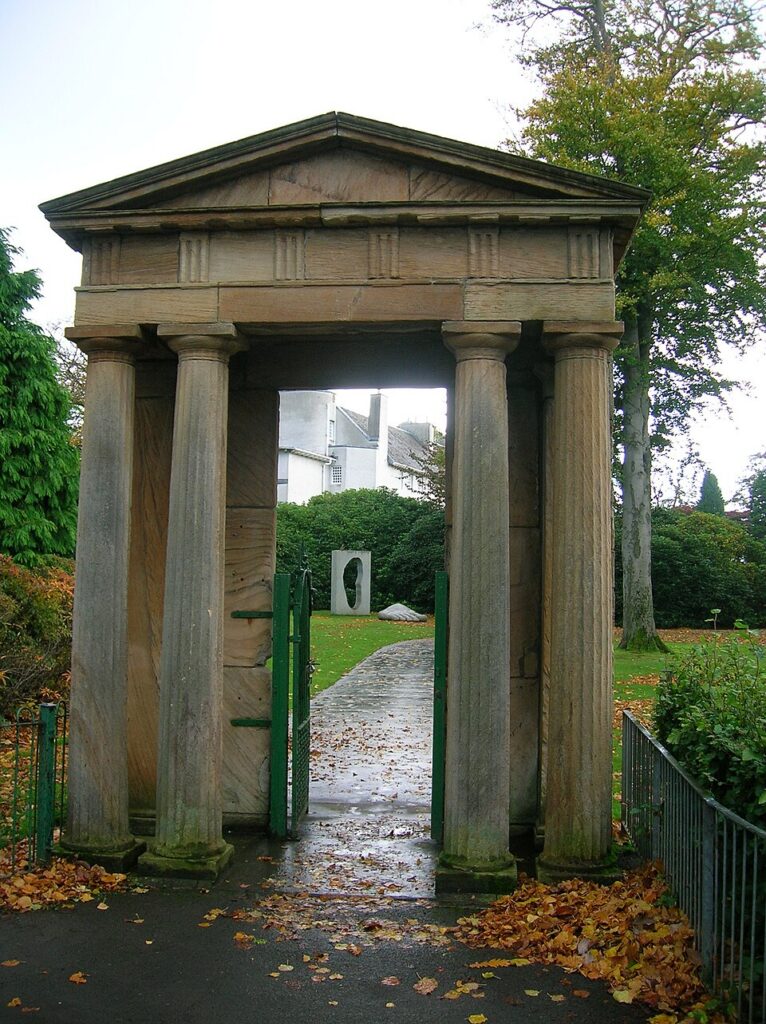
    The Doric portico from the demolished Ibroxhill House, standing in Bellahouston Park, Glasgow.
    The portico from the demolished Ibroxhill House, now standing in Bellahouston Park, where I’ll be running on the 22nd of August
    Photo: Rosser1954 Roger Griffith, public domain, via Wikimedia Commons

    So on the 22nd of August I’ll turn up at Bellahouston Park having just finished Couch to 5K, and run further than I’ve ever run in one go, at whatever pace that turns out to mean. I expect it to be slow, and probably uncomfortable somewhere around the seven or eight kilometre mark where the programme hasn’t taken me yet. I’m not signing up to do well. I’m signing up so that next summer, on the actual Paisley start line, I’ve got something honest to compare it to.

    I’m still not entirely sure I should have said yes. But I think Stephanie was right to talk me into it anyway.

  • From Couch to 10K: My Year-Long Journey to Paisley 10K

    Soundtrack to this post.

    I’m 46, currently working through Couch to 5K (week 6), and I’ve just set myself a proper goal: run the Paisley 10K next year in under 50 minutes.

    Where I’m starting from

    Let’s be honest about the baseline. My most recent run was 4.64 km in 32 minutes 58 seconds, a pace of roughly 7:06 per km. Eight years ago I ran a parkrun 5K in 23 minutes, so I know there’s another gear in there somewhere. It’s just been a while.

    This year’s Paisley 10K is only a couple of weeks away, which is clearly too soon. But next year? That feels like a target worth training for properly.

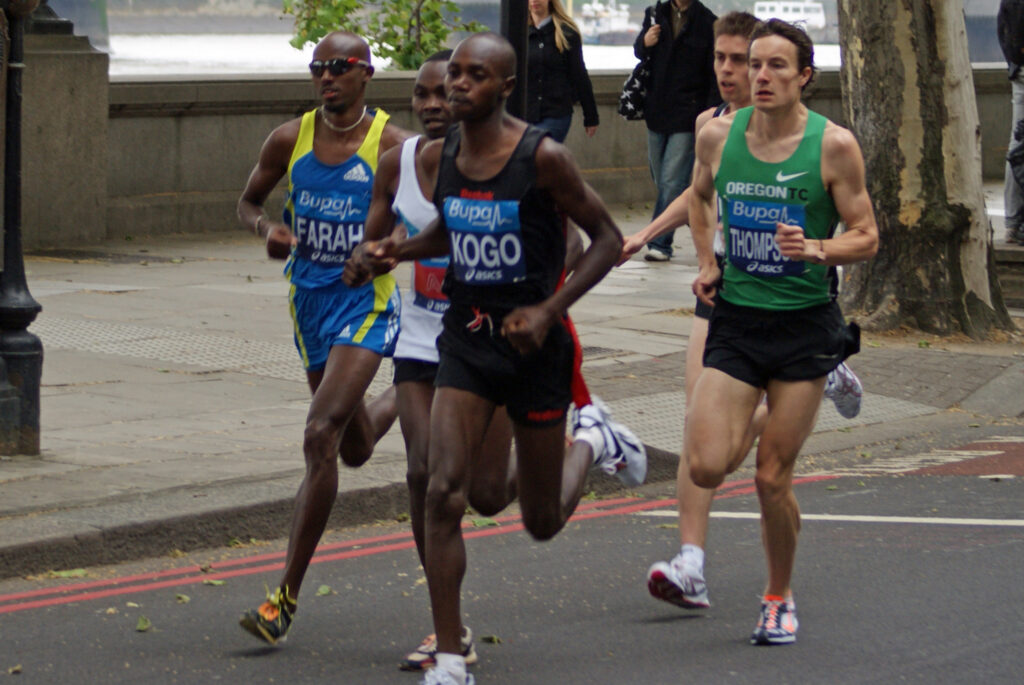
    Elite marathon runners including Mo Farah competing in the 2010 Bupa London 10K road race
    Elite runners at the 2010 Bupa London 10K, the kind of pace I’m chasing over the next year.
    Photo by Julian Mason, via Wikimedia Commons, licensed under CC BY 2.0

    The goal

    50 minutes for 10K means averaging 5:00 per km. Compared to where I am right now, that’s ambitious. Compared to my parkrun pace from 8 years ago (4:36/km), it’s realistic. Somewhere between “achievable” and “will require actual work,” which is exactly where a good goal should sit.

    The plan

    Rather than just wing it, I’ve broken the year into six phases:

    Phase 1, Finish C25K (weeks 1–3): Complete the programme as designed, finishing with a continuous 30-minute 5K.

    Phase 2, 5K consolidation (weeks 4–10): Three runs a week, easy, tempo, and long, plus fortnightly interval sessions. Goal: bring the 5K down to around 26–27 minutes.

    Phase 3, Build to 10K (weeks 11–20): Shift focus to distance using a bridge programme, growing the long run from 5K toward 8–9K, increasing no more than about 10% a week.

    Phase 4, 10K-specific training (weeks 21–36): Four runs a week, with tempo runs tightening toward 5:00/km pace and intervals like 5×1km at 4:45–4:50/km. Long run builds to 12K.

    Phase 5, Peak and taper (weeks 37–44): Race-pace intervals, a long run peaking at 12–14K, then a two-week taper.

    Phase 6, Race week: Easy runs or rest, then race day.

    Checking in along the way

    The plan includes a built-in reality check around month six or seven: if my 5K pace isn’t approaching 4:45–4:50/km by then, 50 minutes might need to shift from “the goal” to “the stretch goal.” Better to know that with months to adjust than to find out in the final week.

    Why write this down publicly

    Partly accountability. It’s harder to quietly let a goal slide when it’s sitting on the internet with your name on it. Partly because I know I’m not the only person starting from a C25K app and wondering if a 10K is really possible in a year. It is. It just takes patience and a plan.

    I’ll post updates as I move through each phase, starting with finishing C25K in the next few weeks.

  • I’ll start tomorrow

    Soundtrack to this post.

    About four months ago I was diagnosed with MS. I’m not going to write a big dramatic post about that part, not today anyway, but I’ll be honest about what it did to me in the short term. There was a bit of depression in there, the kind you don’t always admit to at the time, and I dealt with it the way a lot of people do. I ate. Chocolate mostly. Chocolate has always been my vice and for a few weeks it was more or less a food group.

    The problem is that I also have type 2 diabetes, so emotionally eating my way through bars of chocolate was about the worst thing I could be doing, MS or no MS. And I knew it. I knew I needed to eat better and move more. Every single day I told myself the same thing: I’ll start tomorrow. Tomorrow is a very comfortable place to keep your good intentions. Nothing ever actually has to happen there.

    Then about three weeks ago something just snapped in my head. I can’t point to a single moment or some big realisation. I just woke up done with waiting for tomorrow. I started counting my calories that same day and I joined the gym.

    If you’ve read this blog for any length of time you’ll know I care a lot about privacy, and about choosing what data I hand over to whom. So the obvious tools were out. I wasn’t about to feed every meal into MyFitnessPal or every run into Strava and let them quietly build a picture of my body and my habits. That’s just not for me.

    What I could do was self-host. I set up SparkyFitness for logging my food, which does much the same job as MyFitnessPal but on my own server with my own data staying mine. And I built myself a simple training log for the exercise side. I genuinely enjoyed building it, which is half the appeal. Both have public diaries if you fancy following along:

    [Edit: 20/07/2026] I wasn’t getting on with SparkyFitness. It was quite hard to use on mobile, hard to see, and had loads of features I didn’t use while missing some I wanted. So I made my own version that does exactly what I want with no bloat, called Nourish. The food log and training log are now merged into one at nourish.douglasireland.com/public/douglas-ireland. If you fancy trying Nourish and giving me feedback, it’s at nourish.douglasireland.com.

    On the running side I’ve started Couch to 5K again. If you’ve not come across it, it’s a beginners’ running plan (the NHS version is the one most people in the UK use) that eases you from not running at all up to running 5k. Three sessions a week over nine weeks, starting with short bursts of running in between walking and building up from there. I’m on week 3 as of today.

    To run the plan I use an app called Just Run, which I found on F-Droid. It fits the same rule as everything else here: no ads, no account, no tracking, just a timer that tells you when to run and when to walk. It’s made by a small developer called Jupli and it’s exactly the sort of quiet, does-one-thing-well app I like to give a shout to, so if you’re starting C25K yourself it’s well worth a look.

    Alongside the running I’m keeping my food to around 1800 calories a day.

    I won’t pretend three weeks is long enough to call anything a transformation. But I can honestly say I already feel amazing. Better than I have in a long time, and better than I expected to this soon. Ten years ago I could run a 5k in 23 minutes and I was sitting at a 22.4 BMI. That’s the version of me I’m aiming to get back to. Not to prove anything to anyone, just because I felt good back then and I’d like to feel that way again, MS and diabetes and all.

    If you want to keep an eye on how it’s going, the diaries above update as I do. No login, no tracking, just the numbers.

  • Running, Stopping, and Starting Again.

    Soundtrack to this post.

    I’ve completed the Couch to 5K programme twice before. It’s not magic, but it works. Each time I finished, I felt quietly pleased with myself. I’d reached a point where running 5 kilometres in around half an hour was comfortable. Not easy, exactly, but doable.

    I enjoyed it, too. Or at least, I enjoyed the feeling afterwards. A clear head, lungs awake, the simple satisfaction of having moved my body for half an hour. And yet, both times, gradually and predictably, my trainers ended up back in the cupboard. Days between runs turned into weeks. Motivation faded, routines slipped.

    I’m not running right now because of a back injury. But I’m hoping I’ll start again soon. My aim is simple: run 5K in about 30 minutes, three times a week. The NHS recommends at least 30 minutes of vigorous activity weekly, enough to break a sweat and get properly out of breath, and this ticks that box neatly.

    For anyone unfamiliar, the Couch to 5K (often shortened to C25K) is straightforward. You run three times each week, for nine weeks. Early on, it’s mostly walking, with short bursts of jogging. Over time, the jogging bits get longer, and the walks shorter, until you’re running continuously for half an hour or so. It’s structured, manageable, and it doesn’t assume you’re already fit.

    I’ve never struggled with completing the programme itself. It’s after finishing, once I’ve proven to myself that I can do it, that the difficulty begins. Without a schedule nudging me forward, I slip quietly back into the old routines of not running at all. Maybe the issue is that I think of myself as having ‘finished’ something. Perhaps running isn’t something that can be finished. It’s more of an ongoing conversation between motivation and habit, between intention and routine.

    This time, I wonder if acknowledging this up front might help. There’s no great secret to staying motivated. It’s probably about quiet acceptance that some days I won’t want to run at all. But maybe running anyway, gently defying the urge to stop, will help me find a sustainable rhythm.

    For now, my shoes are waiting. Soon enough, I hope, I’ll be lacing them up again.