Tag: Consumer Rights

  • Stop the Presses: Supreme Court Rules Consumers Apparently Confused by Oats

    Soundtrack to this post.

    If you thought common sense was making a comeback in 2026, I have some bad news for you.

    Today, the UK Supreme Court handed down a final verdict in the long-running, and frankly exhausting, battle between Swedish oat drink maker Oatly and the powerful dairy lobby, Dairy UK. The unanimous ruling is that Oatly has lost the right to trademark their slogan “Post Milk Generation” for their food and drink products.

    Why? Because apparently, the highest court in the land agrees with the dairy industry that the word “milk” is far too confusing for us mere mortals to handle unless it comes directly from an animal’s udder.

    The legal basis for this decision rests on the idea that using “milk” terminology for plant-based products is misleading. The Justices argued that the phrase “Post Milk Generation” did not clearly describe the product’s characteristic (i.e. being dairy-free) and might leave poor, bewildered shoppers wondering if the carton contained no milk or just a little bit of milk.

    I’m sorry, but do they take us for idiots?
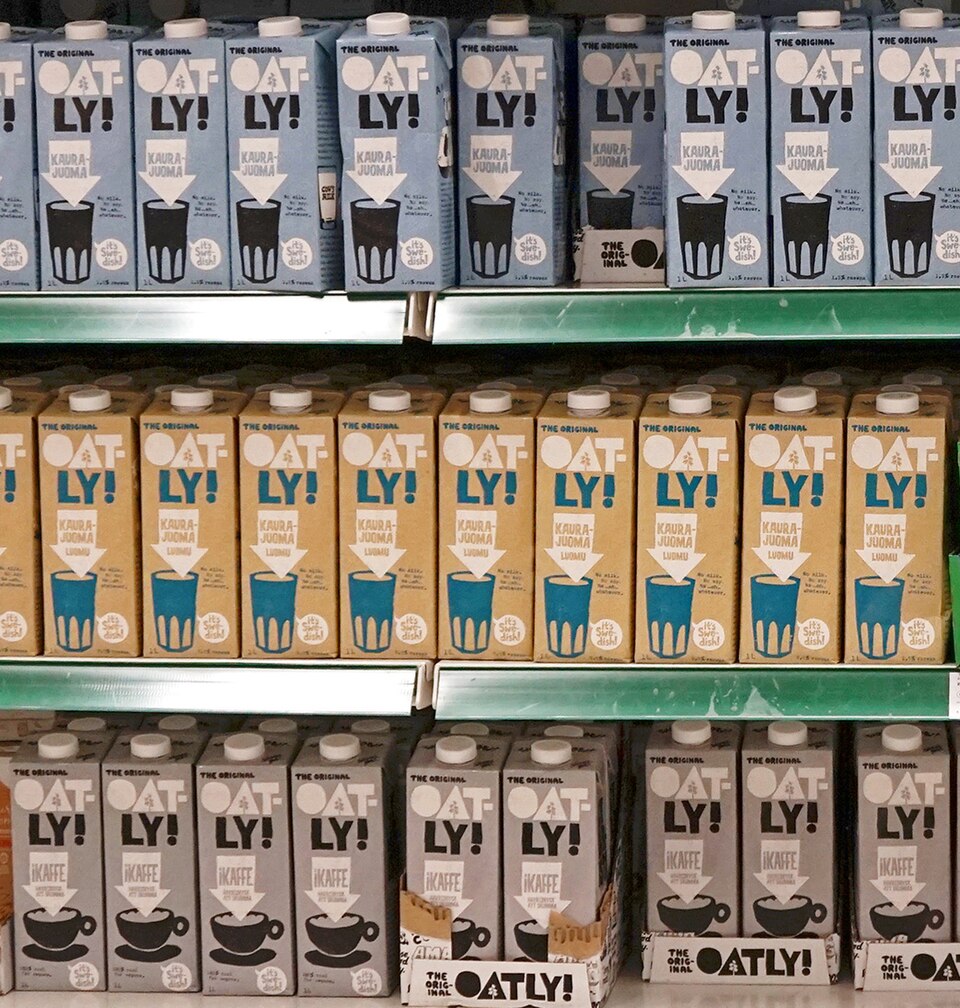
    A variety of Oatly's oat-based drinks on a supermarket shelf.
    A variety of Oatly’s oat-based drinks on a supermarket shelf. The UK Supreme Court has ruled that the company cannot use the word “milk” to describe these plant-based alternatives. Image: Tiia Monto, CC BY-SA 3.0, via Wikimedia Commons

    This ruling is a victory for pedantry over reality. It is a desperate cling to outdated definitions championed by an industry terrified of changing consumer habits.

    Let’s apply this “confusion” logic elsewhere in the supermarket aisle, shall we?

    When I buy fish fingers, I am fully aware that I am not purchasing actual anatomical digits harvested from cod.

    When I buy baby oil, I do not assume it is made from babies.

    When someone buys a veggie burger, nobody, and I mean nobody, is distressed to find a lack of ground beef inside.

    We know that oat milk is squeezed from oats. We know almond milk comes from almonds. We get it. The only people who seem “confused” are the lobbyists running Dairy UK and the lawyers arguing these semantics.

    Oatly’s response hit the nail on the head. Bryan Carroll, their UK general manager, called this what it is: a move to “stifle competition” that “solely benefits Big Dairy.”

    We are living in a time where shifting toward more plant-based diets is crucial for ethical and environmental sustainability. We need to be encouraging these swaps, making them accessible and appealing. Instead, we are wasting years and untold amounts of money in court debating whether the word “milk” can be used to describe a creamy, white liquid that you put on your cereal, just because it didn’t involve a cow.

    The dairy industry is fighting a losing battle against cultural shifts. Trying to fence off common language through legal action will not stop people from choosing sustainable alternatives. It just makes the industry look petty and out of touch.

    The courts might say we are not a “Post Milk Generation” yet, but the consumers already know where the future lies, regardless of what the label is allowed to say.
  • Fugitives in the Pasta Aisle: The Extreme Measures Needed to Protect Your Privacy

    Soundtrack to this post.

    Last month, I wrote about evicting “Big Data” from my digital life. I migrated my entire digital ecosystem onto my own server. It went far beyond simple file storage; I now host my own search engine, media streaming, location tracking, and full personal cloud, reclaiming my digital sovereignty from the likes of Google and Microsoft. It was a technical challenge, but it was a battle I could win. If you own the hardware, you own the rules.

    Stuck in a hospital bed, I have been researching how to apply that same logic to my weekly shop. This is not just an intellectual exercise. When I am discharged, I will be unable to drive for several months. My usual freedom to choose where I spend my money will be gone, shrinking my world down to walking distance. That leaves me with exactly one option: the Tesco just down the road. I would not normally choose them, but geography has made me a captive audience. Hoping to reclaim some agency, I thought I could code a solution from here, but I found the reality is far less forgiving.

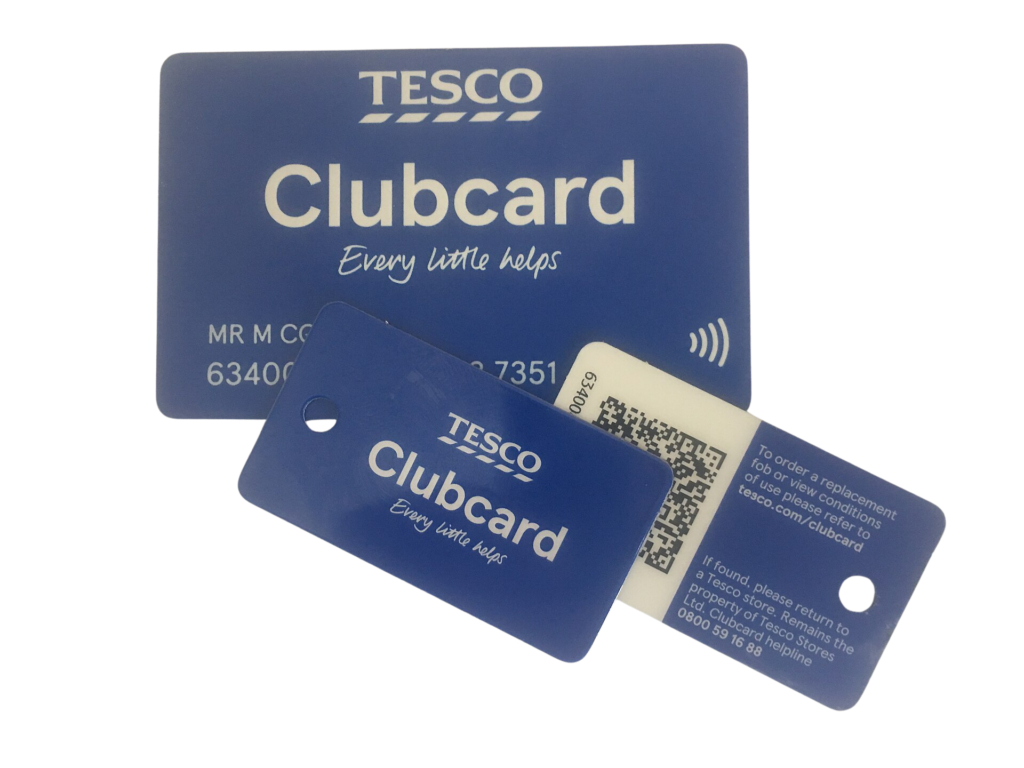
    The physical token of the data tax. To access the standard price, you must carry the tracker. – “The Tesco Clubcard containing contactless technology, and the keyfobs” by Marccoton, licensed under CC BY-SA 4.0.

    We are all familiar with the “Clubcard Price.” You walk down the aisle for coffee or olive oil and see two prices. The first is a reasonable £6.50. The second, for non-members, is a punitive £11.00. For years, we have been trained to view the lower price as a reward, a discount for loyalty. But let us be honest about what this really is. It is not a discount. It is a Data Tax. The £11.00 is a fine you pay for refusing to hand over your identity.

    I had a plan to circumvent this. Being a problem-solver, I thought about launching a service on this site: a “Communal Clubcard.” The idea was simple and socialist in nature. We would share communal cards, pooling our collective bargaining power to get the lower prices without giving Tesco our individual shopping histories. We would pollute their data stream with noise and reclaim the discount.

    It turns out, they are way ahead of me.

    I looked into the logistics, and the pitfalls are designed specifically to crush this kind of collective action. Tesco now uses “velocity checks” to detect if a card is used in Glasgow and London within the same hour, instantly locking the account. They have updated their scanners to reject screenshots of barcodes. They are phasing out physical cards in favour of apps that generate rotating, expiration-prone QR codes.

    They have not just made it difficult to share; they have engineered the system to ensure a one-to-one surveillance ratio. They do not just want a customer to buy the beans; they need to know that Douglas Ireland bought the beans, at what time, and what he bought alongside them.

    This brings me to a depressing realisation. I can self-host my email. I can self-host my photos. But I cannot self-host my groceries.

    In the digital world, open-source software like Nextcloud offers an escape hatch. If you have the skills and the patience, you can opt out of the surveillance economy. In the physical world, that escape hatch is being welded shut. The supermarkets have established a monopoly not just on food, but on the terms of exchange.

    There is a workaround, but it borders on spycraft. To avoid the tracking, I would need to set up a “burner” account with a fake name and a masked email address. Crucially, I would have to pay in cash every single time. If I were to slip up once and use my debit card, their systems could link that payment token to the burner account, retroactively tying every bag of pasta and pint of milk to my real identity.

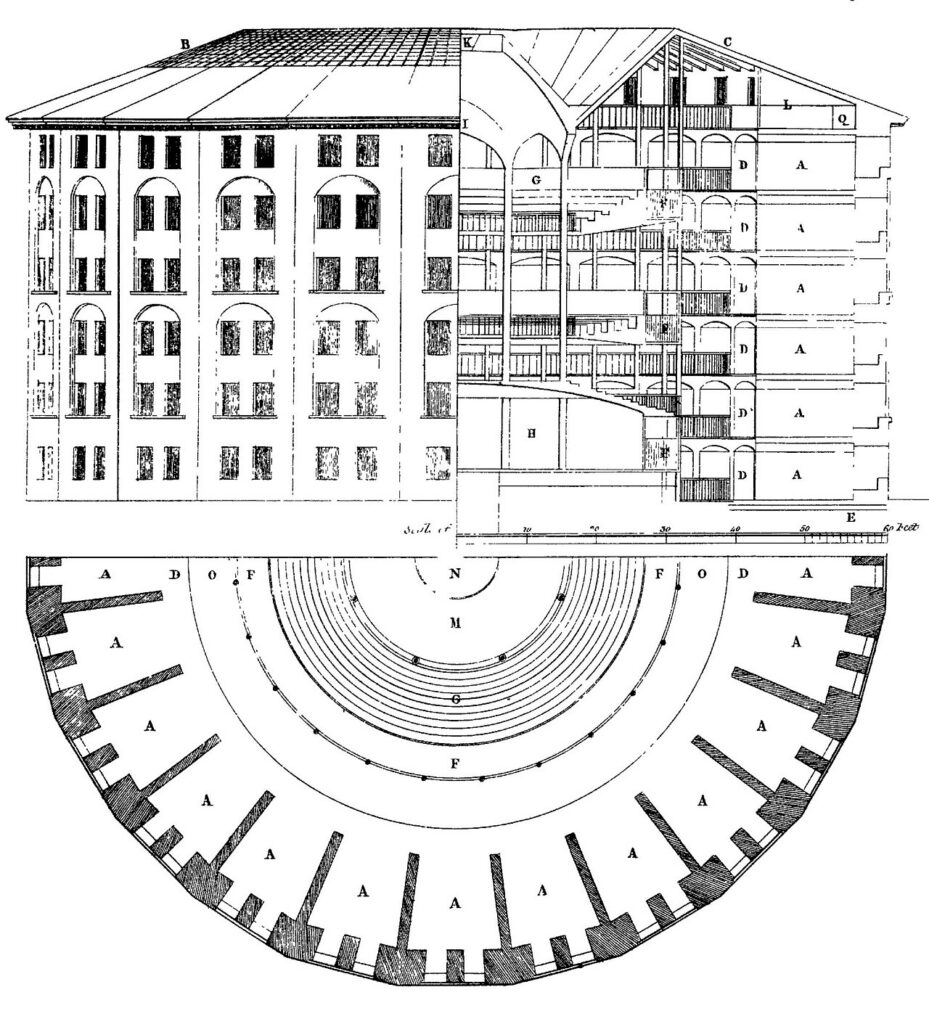
    Jeremy Bentham’s Panopticon (1791). A prison design where the inmates are constantly watched but cannot see the observer; the perfect metaphor for the modern supermarket aisle. – Plan of the Panopticon by Jeremy Bentham (1843), via Wikimedia Commons. Public Domain.

    Is this what privacy has become? A luxury good available only to those willing to act like fugitives in the pasta aisle?

    There is a profound inequality here. We often talk about the “poverty premium,” where being poor costs more (prepayment meters, high-interest loans). We are now seeing the emergence of a “privacy premium.” If you can afford to pay the non-member price, you get to keep your data. If you are struggling with the cost of living, you are forced to sell your privacy just to afford the basics.

    My attempt to build a communal alternative failed because the system is rigged against anonymity. But it was a useful failure. It highlighted that the fight for data sovereignty is not just about servers and code. It is about the right to exist in public spaces without being tracked, indexed, and profiled.

    I might have secured my digital home, but outside the front door, the company town is bigger than ever. And for now, it seems I have to choose between my principles and the price of olive oil.

    I am stuck paying the premium for now. If any readers have found a viable solution, I would be very interested to read about it below or on my Keep in Touch page.