Tag: Digital Localism

  • Fugitives in the Pasta Aisle: The Extreme Measures Needed to Protect Your Privacy

    Soundtrack to this post.

    Last month, I wrote about evicting “Big Data” from my digital life. I migrated my entire digital ecosystem onto my own server. It went far beyond simple file storage; I now host my own search engine, media streaming, location tracking, and full personal cloud, reclaiming my digital sovereignty from the likes of Google and Microsoft. It was a technical challenge, but it was a battle I could win. If you own the hardware, you own the rules.

    Stuck in a hospital bed, I have been researching how to apply that same logic to my weekly shop. This is not just an intellectual exercise. When I am discharged, I will be unable to drive for several months. My usual freedom to choose where I spend my money will be gone, shrinking my world down to walking distance. That leaves me with exactly one option: the Tesco just down the road. I would not normally choose them, but geography has made me a captive audience. Hoping to reclaim some agency, I thought I could code a solution from here, but I found the reality is far less forgiving.
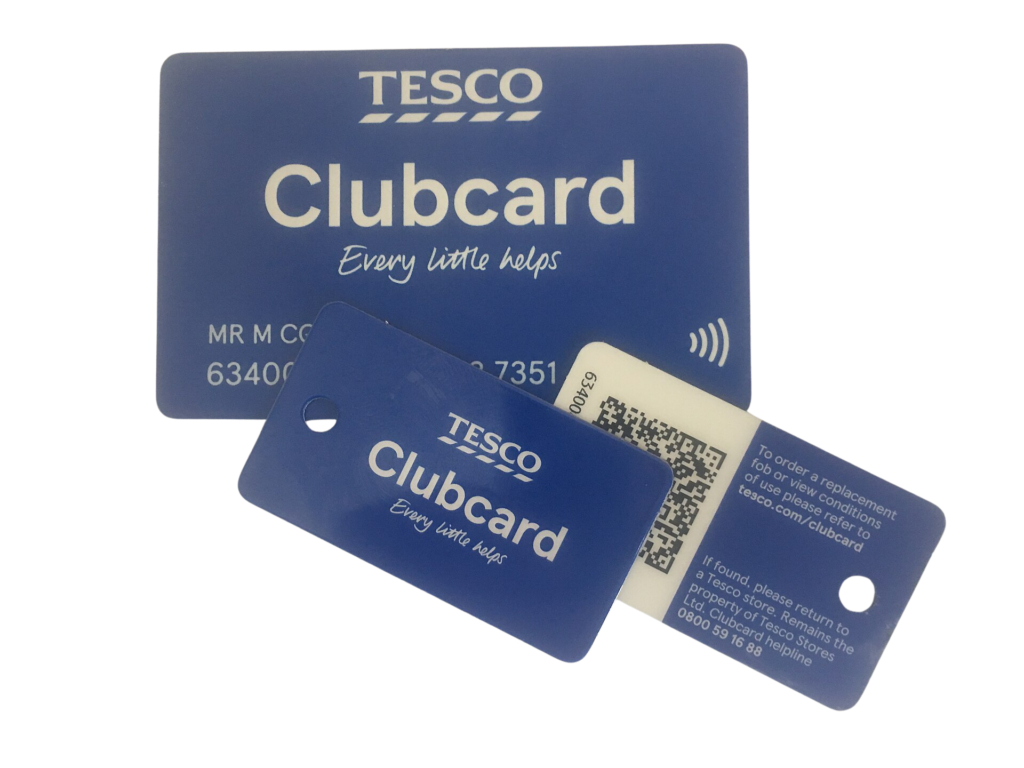
    The physical token of the data tax. To access the standard price, you must carry the tracker. – “The Tesco Clubcard containing contactless technology, and the keyfobs” by Marccoton, licensed under CC BY-SA 4.0.

    We are all familiar with the “Clubcard Price.” You walk down the aisle for coffee or olive oil and see two prices. The first is a reasonable £6.50. The second, for non-members, is a punitive £11.00. For years, we have been trained to view the lower price as a reward, a discount for loyalty. But let us be honest about what this really is. It is not a discount. It is a Data Tax. The £11.00 is a fine you pay for refusing to hand over your identity.

    I had a plan to circumvent this. Being a problem-solver, I thought about launching a service on this site: a “Communal Clubcard.” The idea was simple and socialist in nature. We would share communal cards, pooling our collective bargaining power to get the lower prices without giving Tesco our individual shopping histories. We would pollute their data stream with noise and reclaim the discount.

    It turns out, they are way ahead of me.

    I looked into the logistics, and the pitfalls are designed specifically to crush this kind of collective action. Tesco now uses “velocity checks” to detect if a card is used in Glasgow and London within the same hour, instantly locking the account. They have updated their scanners to reject screenshots of barcodes. They are phasing out physical cards in favour of apps that generate rotating, expiration-prone QR codes.

    They have not just made it difficult to share; they have engineered the system to ensure a one-to-one surveillance ratio. They do not just want a customer to buy the beans; they need to know that Douglas Ireland bought the beans, at what time, and what he bought alongside them.

    This brings me to a depressing realisation. I can self-host my email. I can self-host my photos. But I cannot self-host my groceries.

    In the digital world, open-source software like Nextcloud offers an escape hatch. If you have the skills and the patience, you can opt out of the surveillance economy. In the physical world, that escape hatch is being welded shut. The supermarkets have established a monopoly not just on food, but on the terms of exchange.

    There is a workaround, but it borders on spycraft. To avoid the tracking, I would need to set up a “burner” account with a fake name and a masked email address. Crucially, I would have to pay in cash every single time. If I were to slip up once and use my debit card, their systems could link that payment token to the burner account, retroactively tying every bag of pasta and pint of milk to my real identity.
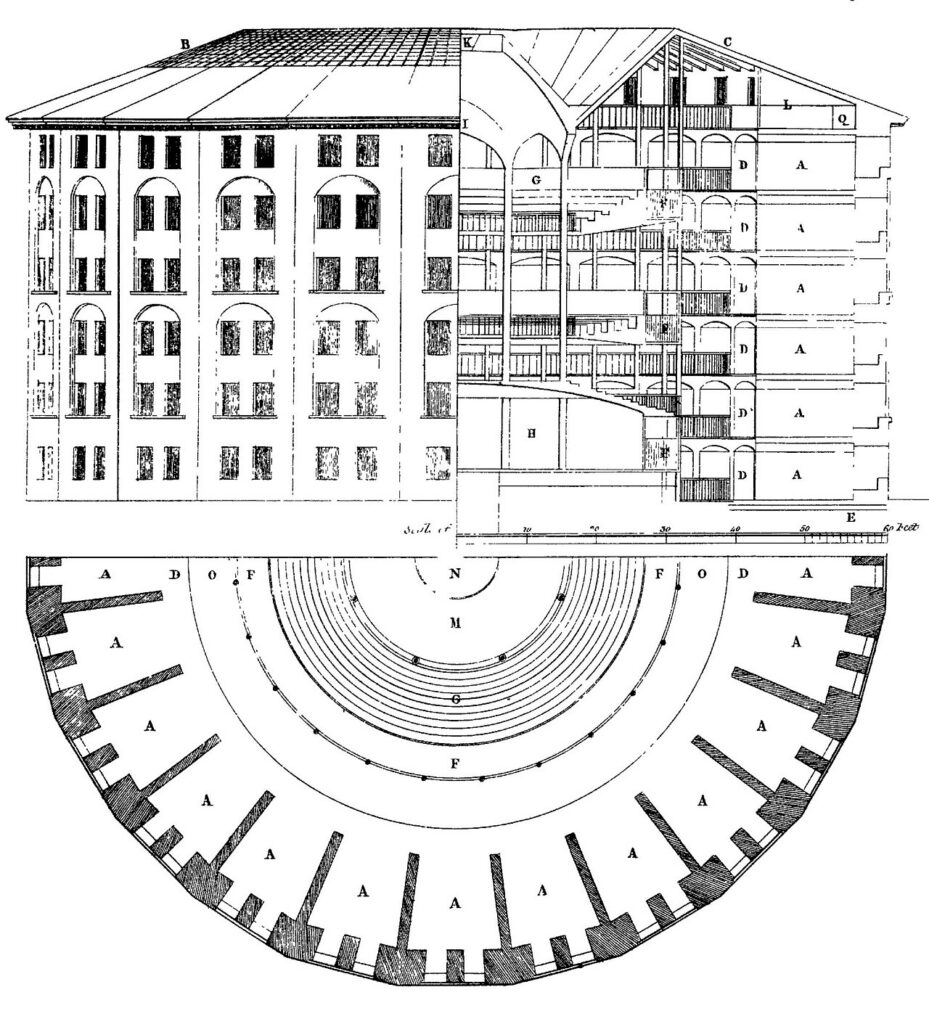
    Jeremy Bentham’s Panopticon (1791). A prison design where the inmates are constantly watched but cannot see the observer; the perfect metaphor for the modern supermarket aisle. – Plan of the Panopticon by Jeremy Bentham (1843), via Wikimedia Commons. Public Domain.

    Is this what privacy has become? A luxury good available only to those willing to act like fugitives in the pasta aisle?

    There is a profound inequality here. We often talk about the “poverty premium,” where being poor costs more (prepayment meters, high-interest loans). We are now seeing the emergence of a “privacy premium.” If you can afford to pay the non-member price, you get to keep your data. If you are struggling with the cost of living, you are forced to sell your privacy just to afford the basics.

    My attempt to build a communal alternative failed because the system is rigged against anonymity. But it was a useful failure. It highlighted that the fight for data sovereignty is not just about servers and code. It is about the right to exist in public spaces without being tracked, indexed, and profiled.

    I might have secured my digital home, but outside the front door, the company town is bigger than ever. And for now, it seems I have to choose between my principles and the price of olive oil.

    I am stuck paying the premium for now. If any readers have found a viable solution, I would be very interested to read about it below or on my Keep in Touch page.

  • Seizing the Means of Connection

    Soundtrack to this post.

    As we enter 2026, many of us are making the usual resolutions to spend less time on our screens or eat more healthily. My resolution is different. I am not trying to spend less time on the internet; I am trying to change how I inhabit it. I am moving “Big Data” out of my life and moving my digital existence onto my own Virtual Private Server (VPS).

    Image: Warded lock
    by Thegreenj
    via Wikimedia Commons, licensed under CC BY-SA 3.0. A threshold to a digital space that belongs to you, not a billionaire.

    This sounds like a technical project, but it is fundamentally a political one. For years, we have lived in digital company towns. We do not own the square where we speak; corporations do. We saw this reality on full display at the start of this year. Men like Elon Musk and Mark Zuckerberg were not just guests at Donald Trump’s second inauguration. They were right at the front, seated in positions of honour that were traditionally reserved for family and cabinet members. It was a clear signal of the increasingly close bond between political power and the billionaire owners of the digital platforms we use every day. We do not own our memories or our data; we merely rent space from them. We have become tenants on digital land that can be sold, gated off, or strip-mined for AI training data at a moment’s notice.

    Aaron Swartz spent his life fighting to liberate knowledge and he understood these power dynamics perfectly. He famously said that information is power. But he also knew that like all power, there are those who want to keep it for themselves.

    Right now, that power is concentrated in a few corporate boardrooms. They treat our data as a raw material to be extracted, which is a modern version of the old enclosures that fenced off the physical commons centuries ago. By self-hosting, we are rejecting this new feudalism. We are stating that our words and connections are not commodities to be monetised by billionaires.

    This is especially vital as we enter the era of AI. If AI is going to eliminate jobs, we have to ask what the new economy will actually look like. In a world where human labour is replaced by machine intelligence, data becomes the primary resource. It is the fuel that runs the entire system. The question of who controls that data is the question of who holds the power in a post-scarcity world.

    In his 1930 essay, “Economic Possibilities for Our Grandchildren,” John Maynard Keynes predicted that by 2030, technological progress would allow us to work only fifteen hours per week. He believed we would have solved the “economic problem” and would instead be grappling with how to spend our newfound leisure time. We are almost at that 2030 deadline, yet the fifteen-hour week feels further away than ever.

    Replacing work should be a good thing. Most people only work because they are paid to do so. But Keynes’s vision failed because the gains from productivity were not distributed; they were captured. If the data that powers the AI future stays in private hands, we will not get leisure. We will get a deeper kind of dependency. Reclaiming our data is the first step in ensuring that a world without work is a world of freedom, not just one of mass unemployment and corporate control.

    There is a misconception that data sovereignty is only for the technical elite. That is no longer the case. The tools to reclaim your data, such as the open-source platform Nextcloud, are now mature and accessible to anyone with a little curiosity. You do not need a computer science degree to stop being a product.

    Admittedly, it is a little less convenient. You have to manage your own backups and occasionally learn how a new piece of software works. However, that small amount of friction is worth the reward. It is the difference between buying a microwave meal and cooking from scratch. When you cook for yourself, you know exactly what is in the pot. You know where the ingredients came from, and you are no longer at the mercy of a corporation’s supply chain.

    You also get to eat in peace. When you host your own services, the advertising disappears. You are no longer being shouted at by brands or tracked by algorithms trying to sell you back a version of yourself. You gain a sense of resilience, a cleaner digital environment, and a deeper understanding of the tools you use every day.

    There is also a hidden environmental cost to the Big Tech model. Because their business relies on extracting and storing every possible scrap of our data to train AI, they have built an infrastructure that is staggeringly wasteful. These data centres consume vast amounts of power and water just to maintain the digital landfill they use for profit. Choosing to self-host is a way to reject that waste. It allows for a more conscious, lean way to live online. When you only host what you actually need, you are practising a form of digital conservation. It is a radical choice that proves “small is beautiful” applies just as much to our servers as it does to our communities.

    My resolution for 2026 is to stop being a digital tenant and become an owner. In a world where every part of our identity is for sale, keeping something for yourself is a revolutionary act.

    Oh, and I’m quitting vaping too, because one form of cloud hosting is probably enough for one year.