Tag: Hospital Life

  • The View from Ward 27

    Soundtrack to this post.
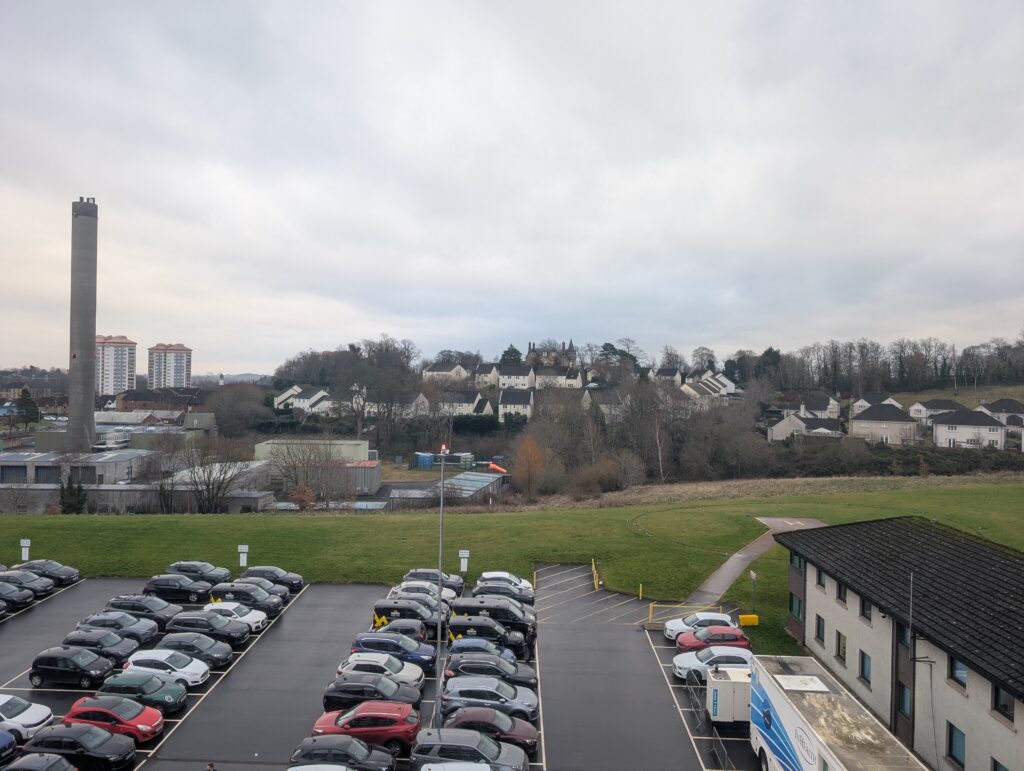
    A view from a high hospital window looking out over Paisley on a cloudy day. In the foreground is a large car park filled with vehicles. To the left stands a tall, thin concrete industrial chimney. In the background, a mix of modern suburban housing and high-rise flats sits in front of rolling green hills. A grassy area in the middle ground contains a helicopter landing pad.
    The view from Ward 27. From the “incinerator” chimney to the Oldbar Hills, with the helipad waiting on the green. Image by Douglas Ireland. Licensed under Creative Commons CC BY-SA 4.0.

    When you are confined to a hospital bed, your world shrinks to the size of a room. The only connection you have to the outside is the window. It becomes your television, your cinema, and your clock.

    I have spent a lot of time staring out of mine.

    The foreground is dominated, as all hospitals are, by the car park. It is a constant ballet of arrivals and departures. You see the relief of people going home and the anxiety of people arriving. It is the most honest theatre in town.

    Beyond the tarmac, the view gets more interesting. To the right, there is a sprawling, somewhat soulless new build estate. It stands in stark contrast to the three solid blocks of council flats rising up in the distance. It is a little slice of social history right there in the architecture.

    Then there is the chimney.

    It is a massive, grey concrete finger pointing at the sky. I have decided, based on absolutely no evidence whatsoever, that this is where they incinerate the amputated body parts. I am sure the hospital facilities manager would tell me it is just the boiler flue or part of the laundry system, but my version fits the mood better.

    In the distance, I can see the tops of the Oldbar Hills. They are a nice reminder that the world is bigger than this ward, and that the weather is doing something other than recirculating through the air conditioning.

    But the real highlight is the helipad.

    Every so often, the air around the hospital changes. The noise builds, the downdraft hits, and the air ambulance comes in to land. It usually arrives from the Scottish Islands, bringing someone across the water for care they can’t get at home.
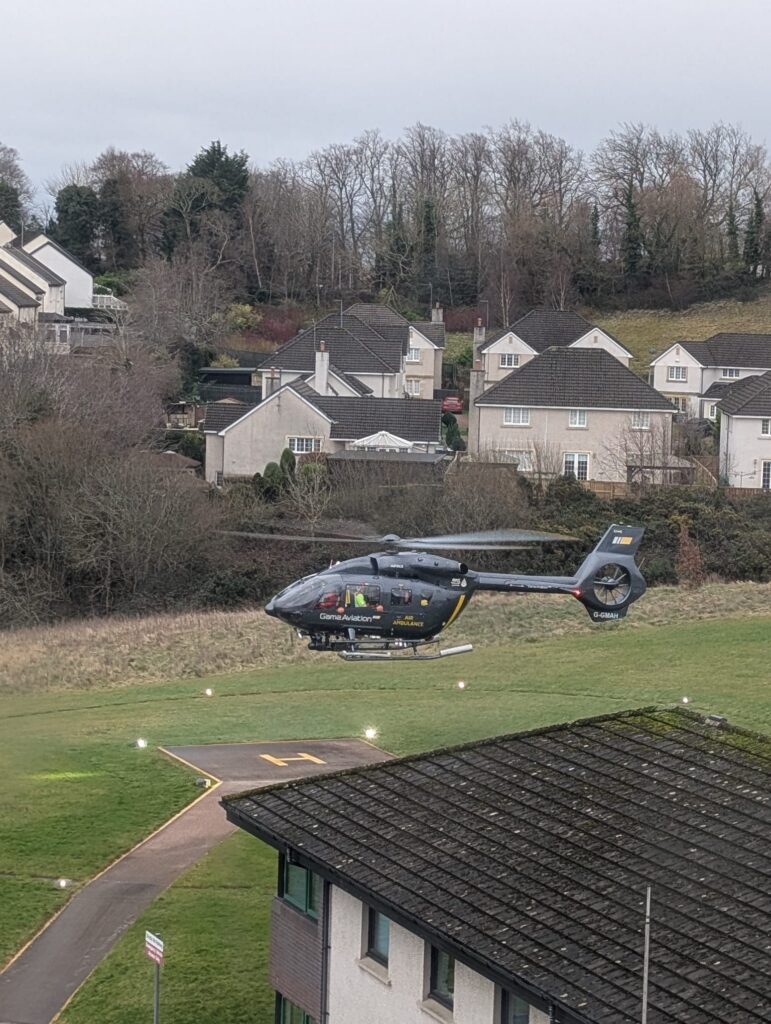
    A dark grey air ambulance helicopter hovering just above a grass landing pad next to a hospital building. In the background are suburban houses and bare winter trees under a grey sky.
    The dramatic disruption of the day: the air ambulance arriving from the islands. Image by Stephanie Crew. Licensed under Creative Commons CC BY-SA 4.0.

    It is a dramatic disruption to the slow routine of the ward. For a few minutes, we all stop what we are doing, patients, nurses, cleaners, and watch the machine touch down. It is a reminder of the incredible logistics that keep this whole system running.

    For now, I am just a spectator. But the view isn’t bad.
  • The High Cost of Being Nasty

    Soundtrack to this post.

    I am currently on day 16 as a guest of the NHS. When you spend this much time on a ward, you have a lot of time to observe the ecosystem around you. You see the stress, the rush, and the incredible patience of the staff.

    Today, while I was down getting a plasma exchange, I spotted a poster on a roll-up banner that stopped me in my tracks. It wasn’t a warning about infections or a guide to washing hands. It was titled INCIVILITY: THE FACTS.

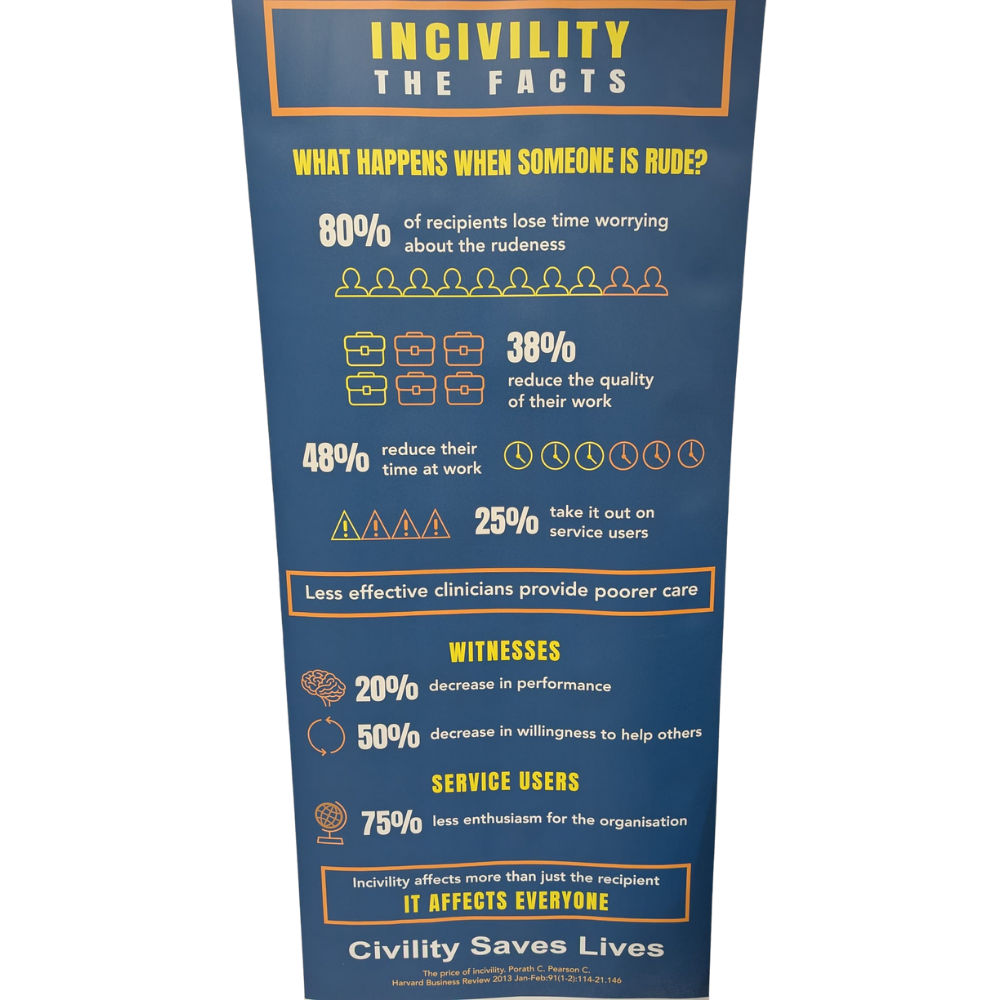
    A blue roll-up banner titled 'INCIVILITY: THE FACTS' displaying statistics on the impact of rudeness. Key figures include: 80% of recipients lose time worrying, 38% reduce work quality, 48% reduce time at work, and 25% take it out on service users. A central box states 'Less effective clinicians provide poorer care.' It also notes that witnesses suffer a 20% decrease in performance, and service users feel 75% less enthusiasm for the organisation. The footer reads: 'Civility Saves Lives.'
    The “Incivility: The Facts” banner I spotted on the ward. A stark reminder that rudeness has a measurable cost to patient care.
    Image by Douglas Ireland. Licensed under Creative Commons CC BY-SA 4.0.

    It turns out that being rude isn’t just unpleasant. It is dangerous.

    The poster laid out the hard data on what happens when someone is rude in a medical setting. The numbers are staggering. 80% of recipients lose time worrying about the rudeness. That is a massive amount of mental energy being diverted away from the job at hand. Even worse, 38% reduce the quality of their work and 48% reduce their time at work.

    In an office job, a 38% drop in quality might mean a bad spreadsheet. In a hospital, as the poster bluntly states, “Less effective clinicians provide poorer care”. The slogan at the bottom really drives it home: Civility Saves Lives.

    It got me thinking about a post I wrote a while back about catching flies with honey rather than vinegar. I wrote then that I had tried vinegar, sharp words and cold silences, and found it useless. This poster proves that it is not just useless; it is actively destructive.

    When you are nasty to someone, you are not just venting your own frustration. You are throwing a wrench in the gears. You are creating a blast radius. The poster notes that even witnesses to rudeness see a 20% decrease in performance and a 50% decrease in willingness to help others.

    Think about that. Being rude to one person makes the people watching half as likely to help someone else. It spreads like a virus.

    I learnt this lesson when I was a toddler. It didn’t take a Harvard Business Review study for me to figure out that it is infinitely easier to get someone to do something for you if you are nice to them. If you scream and stamp your feet, people shut down. If you smile and say please, doors open.

    It is beyond my belief that fully grown adults still struggle with this concept. You see it in shops, in traffic, and sadly, even in hospitals. People seem to think that being aggressive displays dominance or gets results. The data shows it does the exact opposite. It makes the people trying to help you slower, more worried, and less effective.

    My stay here has reaffirmed what I have always suspected. Being nice is not just a “soft” skill. It is an essential survival mechanism. Whether you are trying to get a nurse to check your IV or trying to navigate a difficult meeting at work, civility is the grease that keeps the machine running.

    So, if you can’t be nice just for the sake of being a decent human being, be nice because it is the only way to get anything done. As the banner says, incivility affects everyone.

    We could all do with remembering that politeness costs nothing, but rudeness can cost everything.

  • Sleepless Nights and Side Projects: Building a Game from a Hospital Bed

    There’s nothing quite like a hospital stay to make you appreciate the small things, like silence, privacy, or a decent night’s sleep. Five nights in, and it looks like I’m here for a few more. The highlight of my stay so far? A spinal tap is on the cards. Joy.

    Last night was particularly rough. I couldn’t quite put my finger on whether it was the symphony of snores and other, less pleasant noises from my ward-mates, or just my brain refusing to shut down. Either way, sleep was not on the agenda.

    So, what’s a guy to do at 3 AM in a hospital ward? Well, if you’re me, you pull out your laptop and tinker with a side project. In this case, a lightweight web game designed for a sight-impaired friend.

    The game itself is a simple two-player reflex game. The goal was to make something accessible, private, and functional across both mobile and desktop browsers. No frills, no fuss, just a clean, responsive bit of fun.

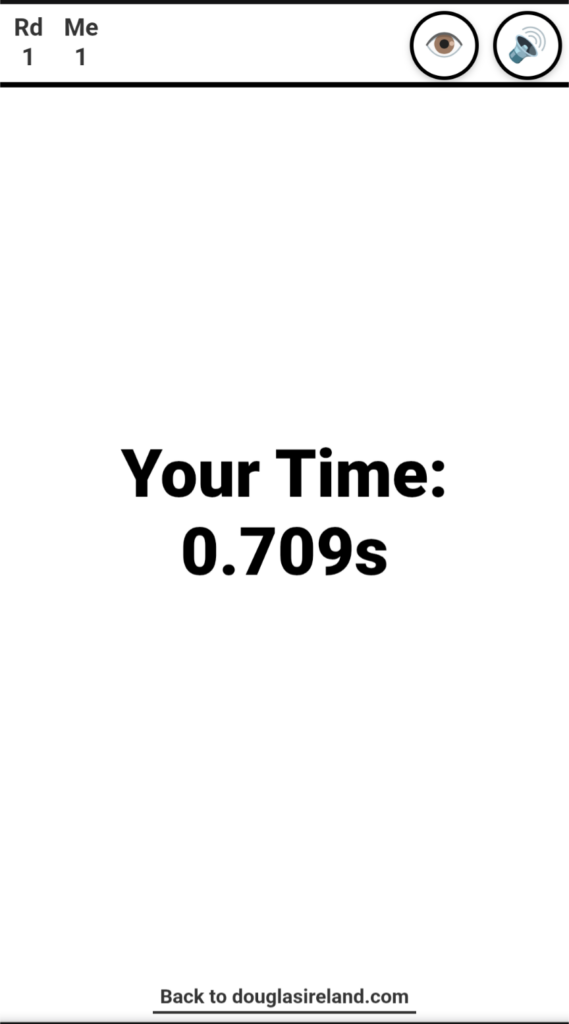
    A screenshot of a mobile web interface displaying a reaction time result. Large, bold text in the centre reads "Your Time: 0.709s". The header displays "Rd 1" and "Me 1" on the left, with eye and speaker icons on the right. A link at the bottom reads "Back to douglasireland.com".
    Screenshot from the game.

    If you’re feeling curious (or just bored), you can give it a shot here: https://reflex.douglasireland.com/. I’d love to hear what you think.

    And if you’re up for a game against a very bored hospital patient, feel free to drop me a line via https://douglasireland.com/chat/. It’s not every day you get to play-test a game from a hospital bed, after all.

    If nothing else, this little project has been a good reminder that even in less-than-ideal circumstances, there’s always something productive (or at least distracting) to be done.