Soundtrack to this post.
I am currently on day 16 as a guest of the NHS. When you spend this much time on a ward, you have a lot of time to observe the ecosystem around you. You see the stress, the rush, and the incredible patience of the staff.
Today, while I was down getting a plasma exchange, I spotted a poster on a roll-up banner that stopped me in my tracks. It wasn’t a warning about infections or a guide to washing hands. It was titled INCIVILITY: THE FACTS.
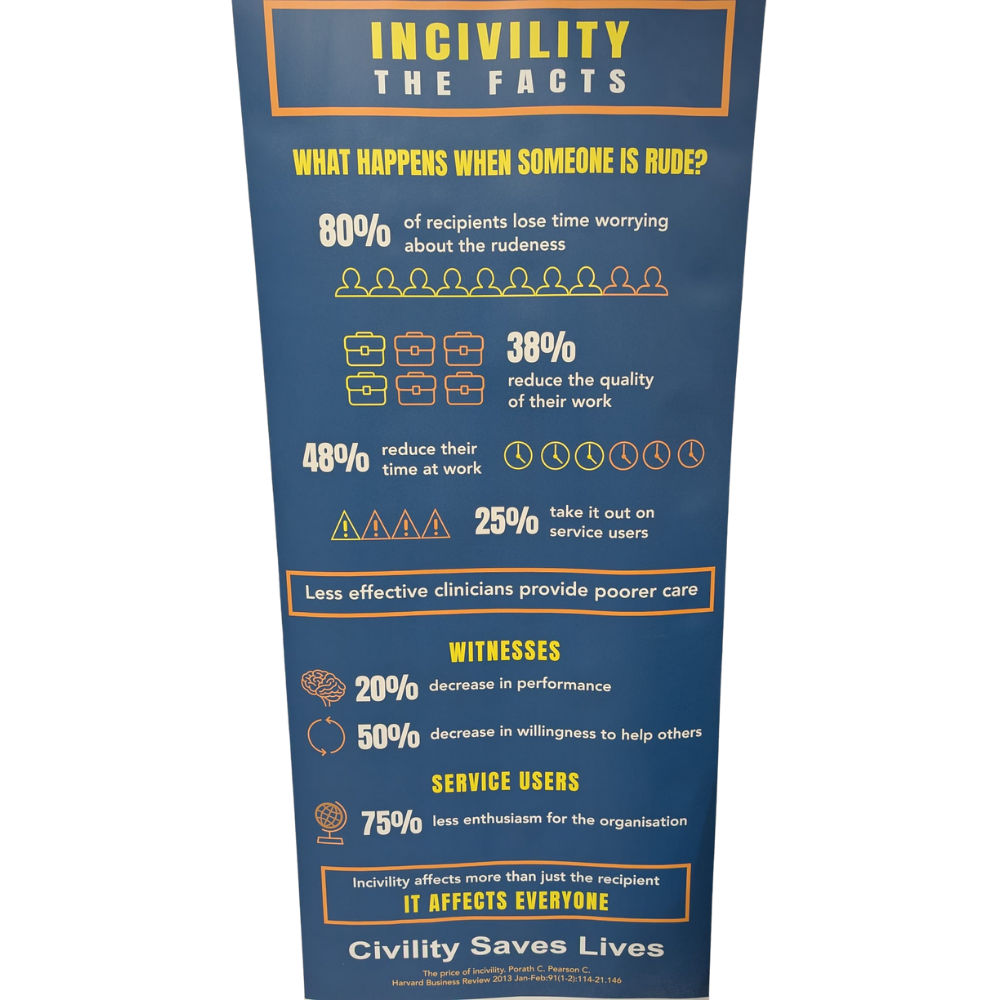
Image by Douglas Ireland. Licensed under Creative Commons CC BY-SA 4.0.
It turns out that being rude isn’t just unpleasant. It is dangerous.
The poster laid out the hard data on what happens when someone is rude in a medical setting. The numbers are staggering. 80% of recipients lose time worrying about the rudeness. That is a massive amount of mental energy being diverted away from the job at hand. Even worse, 38% reduce the quality of their work and 48% reduce their time at work.
In an office job, a 38% drop in quality might mean a bad spreadsheet. In a hospital, as the poster bluntly states, “Less effective clinicians provide poorer care”. The slogan at the bottom really drives it home: Civility Saves Lives.
It got me thinking about a post I wrote a while back about catching flies with honey rather than vinegar. I wrote then that I had tried vinegar, sharp words and cold silences, and found it useless. This poster proves that it is not just useless; it is actively destructive.
When you are nasty to someone, you are not just venting your own frustration. You are throwing a wrench in the gears. You are creating a blast radius. The poster notes that even witnesses to rudeness see a 20% decrease in performance and a 50% decrease in willingness to help others.
Think about that. Being rude to one person makes the people watching half as likely to help someone else. It spreads like a virus.
I learnt this lesson when I was a toddler. It didn’t take a Harvard Business Review study for me to figure out that it is infinitely easier to get someone to do something for you if you are nice to them. If you scream and stamp your feet, people shut down. If you smile and say please, doors open.
It is beyond my belief that fully grown adults still struggle with this concept. You see it in shops, in traffic, and sadly, even in hospitals. People seem to think that being aggressive displays dominance or gets results. The data shows it does the exact opposite. It makes the people trying to help you slower, more worried, and less effective.
My stay here has reaffirmed what I have always suspected. Being nice is not just a “soft” skill. It is an essential survival mechanism. Whether you are trying to get a nurse to check your IV or trying to navigate a difficult meeting at work, civility is the grease that keeps the machine running.
So, if you can’t be nice just for the sake of being a decent human being, be nice because it is the only way to get anything done. As the banner says, incivility affects everyone.
We could all do with remembering that politeness costs nothing, but rudeness can cost everything.