Tag: slow living

  • Smart Enough

    It is raining in Paisley again. A grey, steady drizzle that seems to have set in for the winter.

    I checked the time a moment ago. 7:34 pm.

    I didn’t check it on a screen. I didn’t have to wake a device up, or swipe past a notification about a breaking news story, or see an email I didn’t want to deal with. I just looked at my wrist.

    It was my Casio F-91W.

    I’ve written about this watch before. It costs thirteen quid from Argos. It looks exactly the same as it did in 1991. It tells the time, lights up (badly) if you press a button, and has a stopwatch I rarely use. That is it.

    Lately, though, I have started to see this little piece of resin and plastic as something more than just a retro accessory. I see it as a political statement.

    The Trap of the Upgrade

    We live in an economy built on dissatisfaction. The entire tech industry is designed to make us feel that what we have is old, slow, or broken.

    Batteries are glued in so we can’t replace them. Software updates slow down perfectly good hardware. We are nudged, gently but constantly, to throw away the old and buy the new.

    The environmental cost of this is staggering. The rare earth minerals dug out of the ground, the energy used in manufacturing, the shipping, and finally the e-waste pile where our “old” gadgets go to die after two years.

    It is a cycle of churn that is burning the planet.

    Durability as Defiance
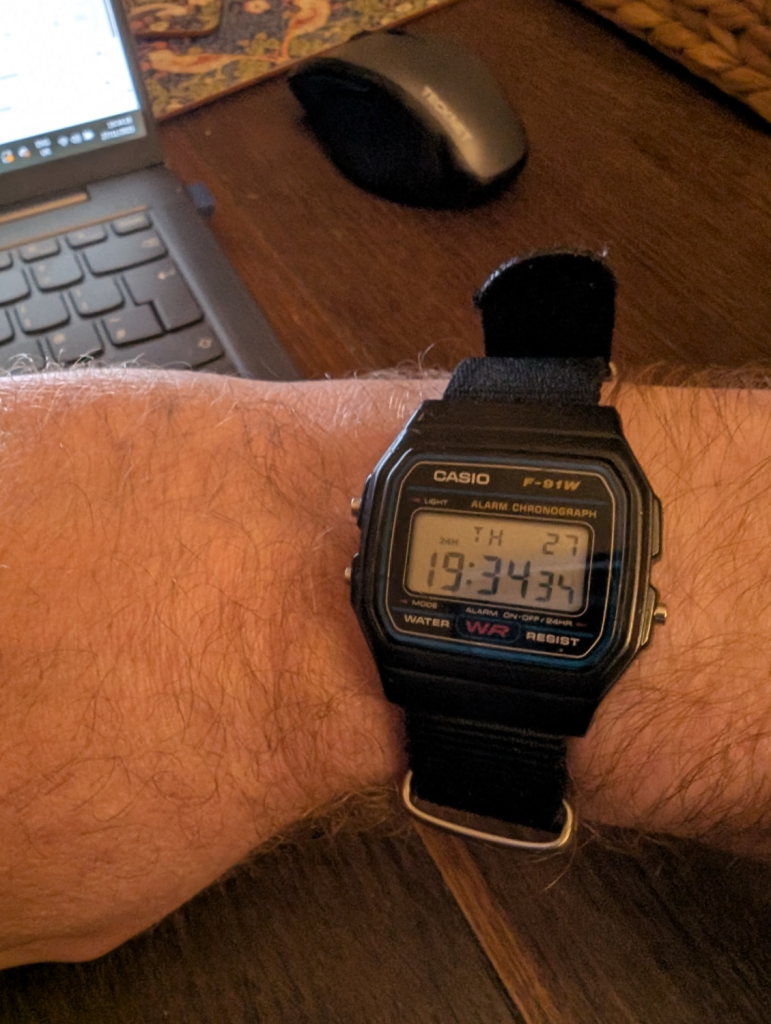
    A close-up of a Casio F-91W digital watch on a wrist, fitted with a black fabric strap. The LCD display reads "TH 27" and the time is 19:34. In the background, a laptop keyboard and wireless mouse sit on a wooden desk.
    “Smart Enough” by Douglas Ireland is licensed under CC BY-NC-ND 4.0.

    This is where the Casio comes in.

    The battery in this watch will last seven years. Maybe ten. When it runs out, I can unscrew the back and put a new one in for pennies. It is not designed to be thrown away. It is designed to work.

    Wearing it feels like a small act of resistance.

    It is a rejection of the idea that everything needs to be “smart.” I don’t need my watch to track my heart rate or tell me the weather or sell me things. I just need it to tell me when it is time to put the tea on.

    There is a concept in Green politics called the Right to Repair. It is the idea that we should legally require companies to make things that last and things we can fix ourselves. It is a massive, necessary shift in how we handle resources.

    But we don’t have to wait for legislation to start living it.

    Enough is Enough

    Choosing “dumb” tech is a way of saying enough.

    Enough noise. Enough tracking. Enough waste.

    It is about finding satisfaction in utility rather than novelty. It is about respecting the materials things are made of, rather than treating them as disposable.

    So yes, it is just a cheap watch. But on a rainy evening in Scotland, with the world trying to sell me everything I don’t need, it feels like the most valuable thing I own.

  • Running, Stopping, and Starting Again.

    I’ve completed the Couch to 5K programme twice before. It’s not magic, but it works. Each time I finished, I felt quietly pleased with myself. I’d reached a point where running 5 kilometres in around half an hour was comfortable. Not easy, exactly, but doable.

    I enjoyed it, too. Or at least, I enjoyed the feeling afterwards. A clear head, lungs awake, the simple satisfaction of having moved my body for half an hour. And yet, both times, gradually and predictably, my trainers ended up back in the cupboard. Days between runs turned into weeks. Motivation faded, routines slipped.

    I’m not running right now because of a back injury. But I’m hoping I’ll start again soon. My aim is simple: run 5K in about 30 minutes, three times a week. The NHS recommends at least 30 minutes of vigorous activity weekly, enough to break a sweat and get properly out of breath, and this ticks that box neatly.

    For anyone unfamiliar, the Couch to 5K (often shortened to C25K) is straightforward. You run three times each week, for nine weeks. Early on, it’s mostly walking, with short bursts of jogging. Over time, the jogging bits get longer, and the walks shorter, until you’re running continuously for half an hour or so. It’s structured, manageable, and it doesn’t assume you’re already fit.

    I’ve never struggled with completing the programme itself. It’s after finishing, once I’ve proven to myself that I can do it, that the difficulty begins. Without a schedule nudging me forward, I slip quietly back into the old routines of not running at all. Maybe the issue is that I think of myself as having ‘finished’ something. Perhaps running isn’t something that can be finished. It’s more of an ongoing conversation between motivation and habit, between intention and routine.

    This time, I wonder if acknowledging this up front might help. There’s no great secret to staying motivated. It’s probably about quiet acceptance that some days I won’t want to run at all. But maybe running anyway, gently defying the urge to stop, will help me find a sustainable rhythm.

    For now, my shoes are waiting. Soon enough, I hope, I’ll be lacing them up again.