Tag: Sustainability

  • Seizing the Means of Connection

    Soundtrack to this post.

    As we enter 2026, many of us are making the usual resolutions to spend less time on our screens or eat more healthily. My resolution is different. I am not trying to spend less time on the internet; I am trying to change how I inhabit it. I am moving “Big Data” out of my life and moving my digital existence onto my own Virtual Private Server (VPS).

    Image: Warded lock
    by Thegreenj
    via Wikimedia Commons, licensed under CC BY-SA 3.0. A threshold to a digital space that belongs to you, not a billionaire.

    This sounds like a technical project, but it is fundamentally a political one. For years, we have lived in digital company towns. We do not own the square where we speak; corporations do. We saw this reality on full display at the start of this year. Men like Elon Musk and Mark Zuckerberg were not just guests at Donald Trump’s second inauguration. They were right at the front, seated in positions of honour that were traditionally reserved for family and cabinet members. It was a clear signal of the increasingly close bond between political power and the billionaire owners of the digital platforms we use every day. We do not own our memories or our data; we merely rent space from them. We have become tenants on digital land that can be sold, gated off, or strip-mined for AI training data at a moment’s notice.

    Aaron Swartz spent his life fighting to liberate knowledge and he understood these power dynamics perfectly. He famously said that information is power. But he also knew that like all power, there are those who want to keep it for themselves.

    Right now, that power is concentrated in a few corporate boardrooms. They treat our data as a raw material to be extracted, which is a modern version of the old enclosures that fenced off the physical commons centuries ago. By self-hosting, we are rejecting this new feudalism. We are stating that our words and connections are not commodities to be monetised by billionaires.

    This is especially vital as we enter the era of AI. If AI is going to eliminate jobs, we have to ask what the new economy will actually look like. In a world where human labour is replaced by machine intelligence, data becomes the primary resource. It is the fuel that runs the entire system. The question of who controls that data is the question of who holds the power in a post-scarcity world.

    In his 1930 essay, “Economic Possibilities for Our Grandchildren,” John Maynard Keynes predicted that by 2030, technological progress would allow us to work only fifteen hours per week. He believed we would have solved the “economic problem” and would instead be grappling with how to spend our newfound leisure time. We are almost at that 2030 deadline, yet the fifteen-hour week feels further away than ever.

    Replacing work should be a good thing. Most people only work because they are paid to do so. But Keynes’s vision failed because the gains from productivity were not distributed; they were captured. If the data that powers the AI future stays in private hands, we will not get leisure. We will get a deeper kind of dependency. Reclaiming our data is the first step in ensuring that a world without work is a world of freedom, not just one of mass unemployment and corporate control.

    There is a misconception that data sovereignty is only for the technical elite. That is no longer the case. The tools to reclaim your data, such as the open-source platform Nextcloud, are now mature and accessible to anyone with a little curiosity. You do not need a computer science degree to stop being a product.

    Admittedly, it is a little less convenient. You have to manage your own backups and occasionally learn how a new piece of software works. However, that small amount of friction is worth the reward. It is the difference between buying a microwave meal and cooking from scratch. When you cook for yourself, you know exactly what is in the pot. You know where the ingredients came from, and you are no longer at the mercy of a corporation’s supply chain.

    You also get to eat in peace. When you host your own services, the advertising disappears. You are no longer being shouted at by brands or tracked by algorithms trying to sell you back a version of yourself. You gain a sense of resilience, a cleaner digital environment, and a deeper understanding of the tools you use every day.

    There is also a hidden environmental cost to the Big Tech model. Because their business relies on extracting and storing every possible scrap of our data to train AI, they have built an infrastructure that is staggeringly wasteful. These data centres consume vast amounts of power and water just to maintain the digital landfill they use for profit. Choosing to self-host is a way to reject that waste. It allows for a more conscious, lean way to live online. When you only host what you actually need, you are practising a form of digital conservation. It is a radical choice that proves “small is beautiful” applies just as much to our servers as it does to our communities.

    My resolution for 2026 is to stop being a digital tenant and become an owner. In a world where every part of our identity is for sale, keeping something for yourself is a revolutionary act.

    Oh, and I’m quitting vaping too, because one form of cloud hosting is probably enough for one year.

  • Smart Enough

    It is raining in Paisley again. A grey, steady drizzle that seems to have set in for the winter.

    I checked the time a moment ago. 7:34 pm.

    I didn’t check it on a screen. I didn’t have to wake a device up, or swipe past a notification about a breaking news story, or see an email I didn’t want to deal with. I just looked at my wrist.

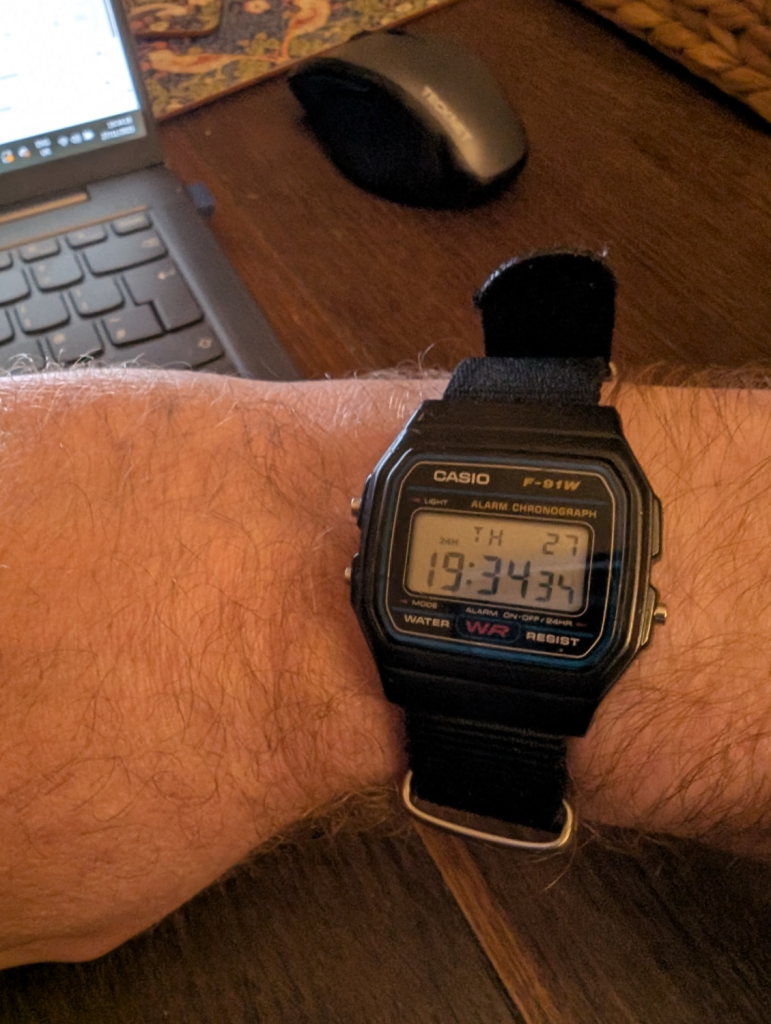
    It was my Casio F-91W.

    I’ve written about this watch before. It costs thirteen quid from Argos. It looks exactly the same as it did in 1991. It tells the time, lights up (badly) if you press a button, and has a stopwatch I rarely use. That is it.

    Lately, though, I have started to see this little piece of resin and plastic as something more than just a retro accessory. I see it as a political statement.

    The Trap of the Upgrade

    We live in an economy built on dissatisfaction. The entire tech industry is designed to make us feel that what we have is old, slow, or broken.

    Batteries are glued in so we can’t replace them. Software updates slow down perfectly good hardware. We are nudged, gently but constantly, to throw away the old and buy the new.

    The environmental cost of this is staggering. The rare earth minerals dug out of the ground, the energy used in manufacturing, the shipping, and finally the e-waste pile where our “old” gadgets go to die after two years.

    It is a cycle of churn that is burning the planet.

    Durability as Defiance

    A close-up of a Casio F-91W digital watch on a wrist, fitted with a black fabric strap. The LCD display reads "TH 27" and the time is 19:34. In the background, a laptop keyboard and wireless mouse sit on a wooden desk.
    “Smart Enough” by Douglas Ireland is licensed under CC BY-NC-ND 4.0.

    This is where the Casio comes in.

    The battery in this watch will last seven years. Maybe ten. When it runs out, I can unscrew the back and put a new one in for pennies. It is not designed to be thrown away. It is designed to work.

    Wearing it feels like a small act of resistance.

    It is a rejection of the idea that everything needs to be “smart.” I don’t need my watch to track my heart rate or tell me the weather or sell me things. I just need it to tell me when it is time to put the tea on.

    There is a concept in Green politics called the Right to Repair. It is the idea that we should legally require companies to make things that last and things we can fix ourselves. It is a massive, necessary shift in how we handle resources.

    But we don’t have to wait for legislation to start living it.

    Enough is Enough

    Choosing “dumb” tech is a way of saying enough.

    Enough noise. Enough tracking. Enough waste.

    It is about finding satisfaction in utility rather than novelty. It is about respecting the materials things are made of, rather than treating them as disposable.

    So yes, it is just a cheap watch. But on a rainy evening in Scotland, with the world trying to sell me everything I don’t need, it feels like the most valuable thing I own.