Tag: Technology

  • Smart Enough

    It is raining in Paisley again. A grey, steady drizzle that seems to have set in for the winter.

    I checked the time a moment ago. 7:34 pm.

    I didn’t check it on a screen. I didn’t have to wake a device up, or swipe past a notification about a breaking news story, or see an email I didn’t want to deal with. I just looked at my wrist.

    It was my Casio F-91W.

    I’ve written about this watch before. It costs thirteen quid from Argos. It looks exactly the same as it did in 1991. It tells the time, lights up (badly) if you press a button, and has a stopwatch I rarely use. That is it.

    Lately, though, I have started to see this little piece of resin and plastic as something more than just a retro accessory. I see it as a political statement.

    The Trap of the Upgrade

    We live in an economy built on dissatisfaction. The entire tech industry is designed to make us feel that what we have is old, slow, or broken.

    Batteries are glued in so we can’t replace them. Software updates slow down perfectly good hardware. We are nudged, gently but constantly, to throw away the old and buy the new.

    The environmental cost of this is staggering. The rare earth minerals dug out of the ground, the energy used in manufacturing, the shipping, and finally the e-waste pile where our “old” gadgets go to die after two years.

    It is a cycle of churn that is burning the planet.

    Durability as Defiance
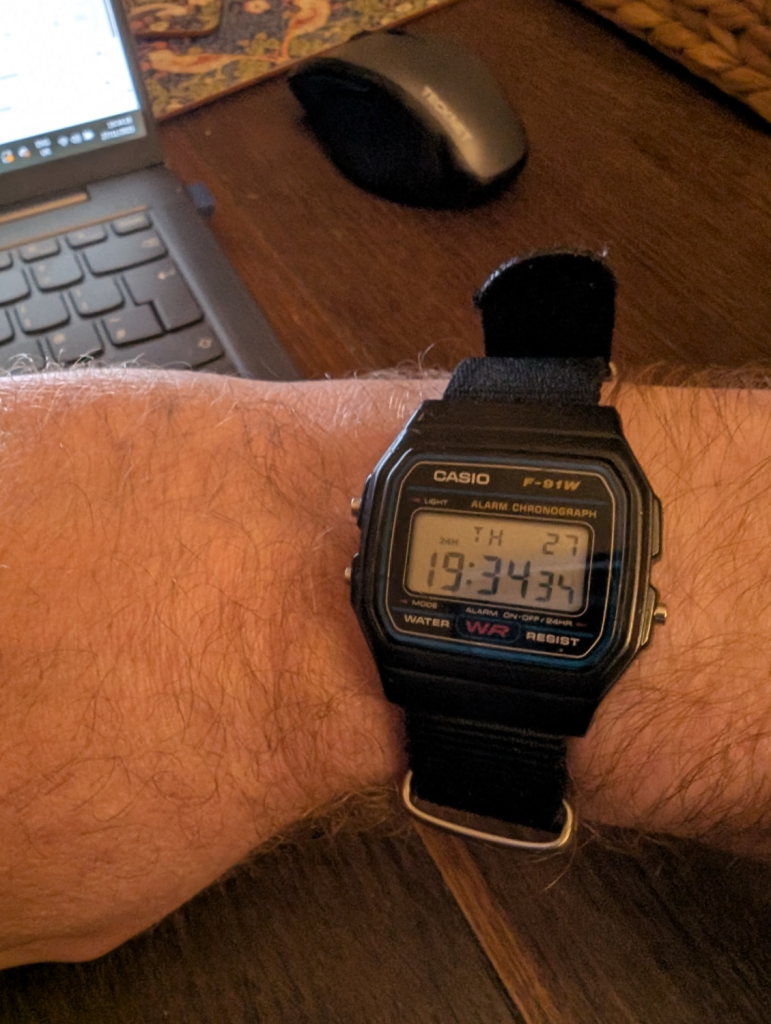
    A close-up of a Casio F-91W digital watch on a wrist, fitted with a black fabric strap. The LCD display reads "TH 27" and the time is 19:34. In the background, a laptop keyboard and wireless mouse sit on a wooden desk.
    “Smart Enough” by Douglas Ireland is licensed under CC BY-NC-ND 4.0.

    This is where the Casio comes in.

    The battery in this watch will last seven years. Maybe ten. When it runs out, I can unscrew the back and put a new one in for pennies. It is not designed to be thrown away. It is designed to work.

    Wearing it feels like a small act of resistance.

    It is a rejection of the idea that everything needs to be “smart.” I don’t need my watch to track my heart rate or tell me the weather or sell me things. I just need it to tell me when it is time to put the tea on.

    There is a concept in Green politics called the Right to Repair. It is the idea that we should legally require companies to make things that last and things we can fix ourselves. It is a massive, necessary shift in how we handle resources.

    But we don’t have to wait for legislation to start living it.

    Enough is Enough

    Choosing “dumb” tech is a way of saying enough.

    Enough noise. Enough tracking. Enough waste.

    It is about finding satisfaction in utility rather than novelty. It is about respecting the materials things are made of, rather than treating them as disposable.

    So yes, it is just a cheap watch. But on a rainy evening in Scotland, with the world trying to sell me everything I don’t need, it feels like the most valuable thing I own.

  • An Act of Digital Citizenship: Why I’m Still Donating to Wikipedia

    The email arrived today, right on schedule. It was from the Wikimedia Foundation, kindly reminding me that I had donated £5 last year and asking if I would consider renewing my support.
    My gut reaction was to hesitate. Do I actually use Wikipedia that much? The answer is no.


    My habits have changed. Like many people, when I want to know something now, I don’t open a new tab and type “wikipedia.org”. I open a chat with an AI. I ask my question in plain language and get a synthesized, conversational answer in seconds. It’s an incredible technology that has seamlessly integrated itself into my workflow.
    So, why donate to the encyclopedia I seem to have replaced?


    I was about to archive the email when I stopped and thought about the process more deeply. Where does this helpful AI get its information? How does it know the history of Paisley, the principles of thermodynamics, or the discography of my favourite band?
    Of course, it learns from a vast corpus of data scraped from the internet. A massive, foundational pillar of that data is Wikipedia. It’s perhaps the most significant single source of structured human knowledge online.


    That’s when it clicked. Wikipedia is no longer just a website I visit. It has become a fundamental piece of our shared digital commons.
    It’s like Barshaw Park for the internet.

    Barshaw Park: the Peace Garden” by Lairich Rig is licensed under CC BY-SA 2.0.

    It’s a vast, open space, built and tended to by a global community of volunteers. It is free for everyone to enter. It doesn’t plaster its beautiful landscapes with ads or charge an entry fee. Its purpose isn’t to make a profit, but simply to exist for the public good.


    My AI is like a fantastic personal tour guide. I can ask it anything about the park’s history or features, and it will instantly give me a brilliant, summarised tour. But that guide doesn’t build the paths, tend the gardens, or pick up the litter. The community does that.


    And like any public space, if it is neglected, it will fall into disrepair. The paths will crack, the gardens will become overgrown, and misinformation will spread like graffiti. If the commons degrades, the quality of every service that relies on it, including the AI I now find so useful, degrades too.


    That’s why I went back to that email and renewed my £5 donation.
    I don’t see it as paying for a product I no longer use. I see it as an act of digital citizenship. I’m chipping in for the park’s upkeep. It’s a tiny contribution to help maintain this incredible non-commercial, human-curated resource in an online world that is becoming more automated and commercialised by the day.


    By supporting Wikipedia, we are all helping to ensure that a neutral, verifiable source of knowledge remains healthy. We are funding the digital gardeners. We’re ensuring this public park remains a vital counterbalance to the noise and potential biases of the wider web.


    So, while I may ask an AI for my facts these days, I know that my donation helps ensure the park my ‘tour guide’ relies on remains a beautiful, trustworthy, and essential place for all of us. It’s a small investment in the health of the internet itself.


    If you also believe in that mission, perhaps you’ll consider joining me. Donate to Wikipedia here