What are people actually looking forward to if Reform wins the next General Election and forms a government?
Is it the generous tax cuts that will inevitably gut public services across the country, leading to the slow dismantling of everything from libraries to local councils, already held together by little more than duct tape and goodwill?
Maybe it’s the vision of a skeleton Civil Service, hollowed out in the name of “efficiency,” where job cuts are spun as progress and oversight becomes optional.
How about the long-rumoured privatisation of the NHS? Selling off the very institution people clap for, while quietly preparing us to pay American prices for insulin and A&E visits?
Perhaps you’re excited for chlorine-washed chicken and hormone-laced beef, as British food standards are sacrificed for post-Brexit trade deals that no one asked for.
There’s also the small matter of workers’ rights. What could be more liberating than losing your right to union protection, fair dismissal processes, or sick pay?
Then there’s the slow erosion of bodily autonomy, with hard-won reproductive rights under threat, framed as a return to “traditional values.”
And we can’t forget the overt bigotry that appears regularly in the words and tweets of many Reform candidates. This seems to be a feature, not a bug.
So I ask again, in all seriousness, with just a touch of sarcasm:
What is it you’re most looking forward to when Reform takes the reins?
Because I suspect the people clapping them into power may not be ready for what happens when the applause stops and the policies begin.
I’d love to hear your thoughts.
Do you agree, disagree, or have your own worries about a Reform government? Drop a comment below and let’s talk about it.
Author: Douglas Ireland
-
Running, Stopping, and Starting Again.
I’ve completed the Couch to 5K programme twice before. It’s not magic, but it works. Each time I finished, I felt quietly pleased with myself. I’d reached a point where running 5 kilometres in around half an hour was comfortable. Not easy, exactly, but doable.
I enjoyed it, too. Or at least, I enjoyed the feeling afterwards. A clear head, lungs awake, the simple satisfaction of having moved my body for half an hour. And yet, both times, gradually and predictably, my trainers ended up back in the cupboard. Days between runs turned into weeks. Motivation faded, routines slipped.
I’m not running right now because of a back injury. But I’m hoping I’ll start again soon. My aim is simple: run 5K in about 30 minutes, three times a week. The NHS recommends at least 30 minutes of vigorous activity weekly, enough to break a sweat and get properly out of breath, and this ticks that box neatly.
For anyone unfamiliar, the Couch to 5K (often shortened to C25K) is straightforward. You run three times each week, for nine weeks. Early on, it’s mostly walking, with short bursts of jogging. Over time, the jogging bits get longer, and the walks shorter, until you’re running continuously for half an hour or so. It’s structured, manageable, and it doesn’t assume you’re already fit.
I’ve never struggled with completing the programme itself. It’s after finishing, once I’ve proven to myself that I can do it, that the difficulty begins. Without a schedule nudging me forward, I slip quietly back into the old routines of not running at all. Maybe the issue is that I think of myself as having ‘finished’ something. Perhaps running isn’t something that can be finished. It’s more of an ongoing conversation between motivation and habit, between intention and routine.
This time, I wonder if acknowledging this up front might help. There’s no great secret to staying motivated. It’s probably about quiet acceptance that some days I won’t want to run at all. But maybe running anyway, gently defying the urge to stop, will help me find a sustainable rhythm.
For now, my shoes are waiting. Soon enough, I hope, I’ll be lacing them up again.
-
The Nap That Ate the Evening
We had a plan.
Gym bags by the door. Water bottles filled. The noble intention of movement pencilled in for after work.
But then the sofa looked inviting. And the thought of a “quick refreshing nap” crept in like a cunning little idea. Just twenty minutes, we said. Just a recharge. Nothing serious.
Two hours later, we woke up bleary-eyed, limbs heavy, the room dimmer than before. Not quite sure where we were in the day. Definitely not at the gym.
Now we’re talking about takeaway, not treadmills. Chatting about what kind of beer to pick up instead of whether to do intervals or a long slow stretch on the mat. There’s a quiet agreement between us. No mention of the gym. We are both gracefully, strategically, ignoring it.
We’ve let the monkey mind steer the ship tonight. The part of us that likes naps and noodles more than effort and structure. And honestly, I’m not even mad.
There’s something funny and human about it. We try to keep it all together. Health, routine, responsibility. But now and then it slips. Or we let it slip. Sometimes what we need isn’t discipline. Sometimes it’s just a pause, a laugh, and a decent curry.
Maybe tomorrow we’ll do better. Maybe not. But for now, I’m just glad we’re in it together.
-
Like Shit Off a Shovel
I first got online in 1994. Back then, just saying that felt futuristic. Most people I knew didn’t have the internet at all. You had to dial in, literally. That high-pitched screech of a modem connecting was the sound of something new.
We called it the information superhighway, and it really did feel like that, a strange and open road with no clear destination. You just explored.
The web was small. Pages were mostly grey. Text was blue and underlined. If you wanted a picture, it took time to load. Search engines weren’t very good. But there was something honest about it. You were more likely to stumble upon someone’s handmade website or message board than be guided by an algorithm. It felt like wandering.
I remember someone in my family trying my 28.8k modem for the first time. After watching a page load faster than expected, they leaned back and said, “That thing goes like shit off a shovel.” At the time, it really did feel like that.
I spent time on Usenet newsgroups, where people held long, often thoughtful discussions, threaded and searchable. And I used IRC, where you could drop into a channel and chat in real time with strangers from around the world. There was something raw but real about it. No profiles. No bios. Just usernames and conversation.
There was no social media, no feeds, no notifications. If you wanted to connect with someone, you’d read their post or their homepage and send them an email. Maybe they’d write back. It was slow in the best way.
Now the internet is always on, always loud. Every platform wants your attention. Content is chopped into algorithms and pushed into your day whether you asked for it or not. People compete for visibility, likes, reach. It’s not all bad, but it’s a long way from how it started.
I’ve been thinking about that a lot lately. About how the internet used to be made up of small, personal spaces. And how it could be that again, at least in a quiet corner.
That’s what I’m trying to build here. This site doesn’t run on likes or shares. I don’t have to post at the right time or follow trends. I just write when I want to. People can leave a comment if they feel like it. Or not.
The difference is, I control this space. No ads. No feeds. Just a small corner of the internet where I can show up as myself.
It might seem old-fashioned, but I don’t mind that. I’m from the dial-up days. And I still think there’s something worth keeping from that time.
At the same time, I’m not anti-technology. Quite the opposite. I still get excited about new ideas and tools, especially AI. I think we’re only just beginning to see how it’s going to change how we work, create, communicate and learn. Used well, it can help us cut through noise, automate the boring stuff, and make space for more human connection, not less.
So I’m not turning my back on the future. I just want to bring a little more of the past into it.
-
Moved a Bit, Felt Better
Bank holiday Monday. No rush, no pressure. Just the quiet decision to go back to the gym for the first time in a while.
I’ve been out of action since a herniated disc left me in hospital for four nights. It’s been a slow recovery, and today felt like the right time to move again. I wrote a bit about that in Showing Up, but this was the first time I’ve really been back in the gym properly.
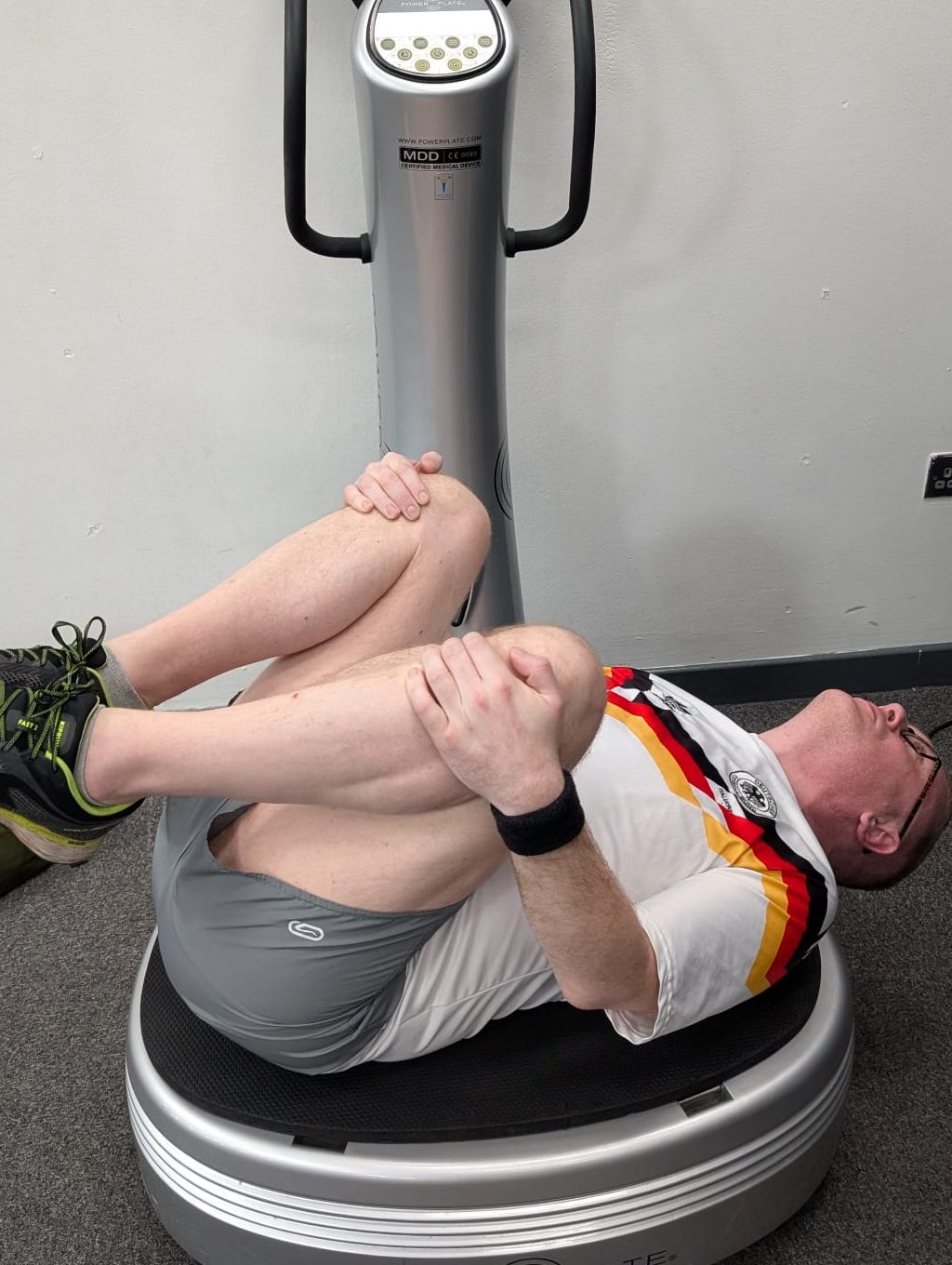
Starting slow on the Power Plate. This position helps release my lower back. After the Power Plate, I hit the treadmill. No incline, just a brisk pace. Music in my ears, a workout supermix, and a steady rhythm that felt surprisingly good. By 22 minutes I was breaking a sweat. I finished at 30 minutes, 3.03 km. Not pushing it. Just showing up, moving, breathing.
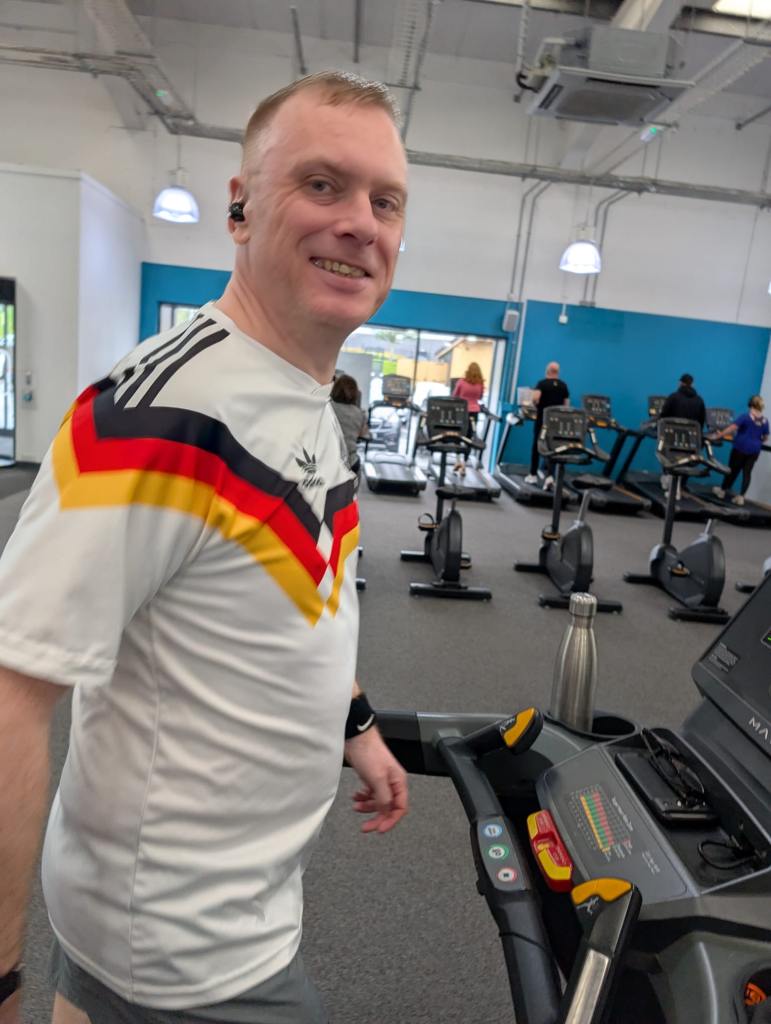
30 minutes on the treadmill. My favourite kit, the West Germany shirt from Italia 90. Then it was time for some yoga with Stephanie. We kept it gentle. Yin yoga, slow and supported. Four poses, all on the mat.
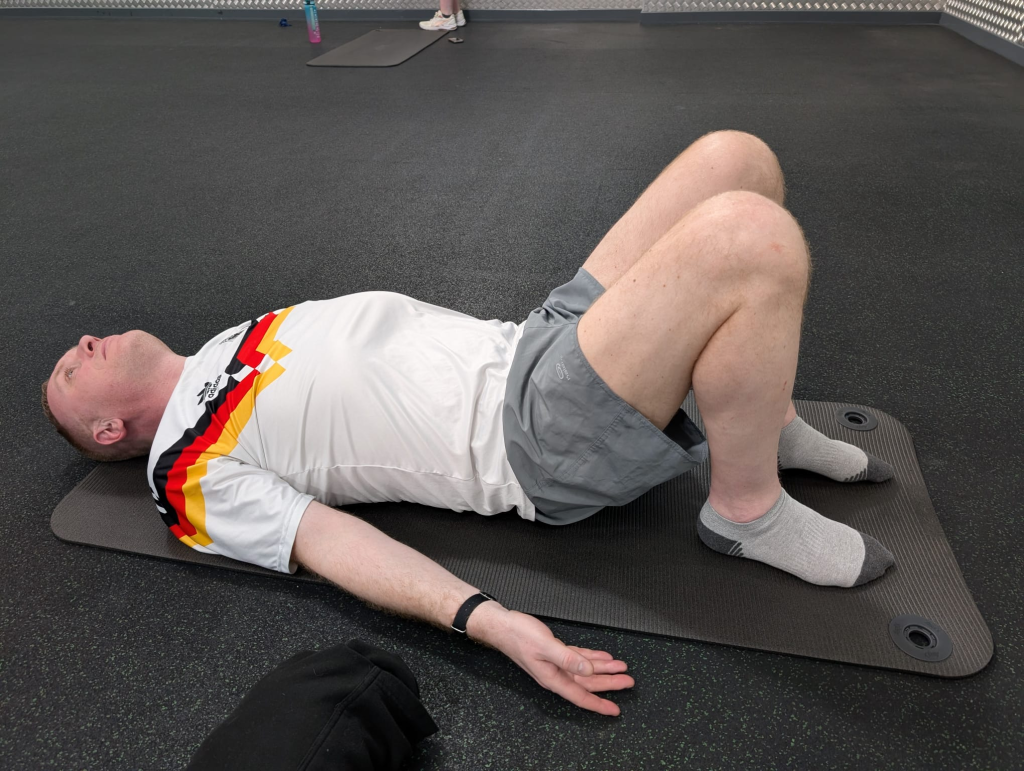
Positive rest. A way to let the nervous system settle before stretching. Allowing the spine to reset to its natural position. 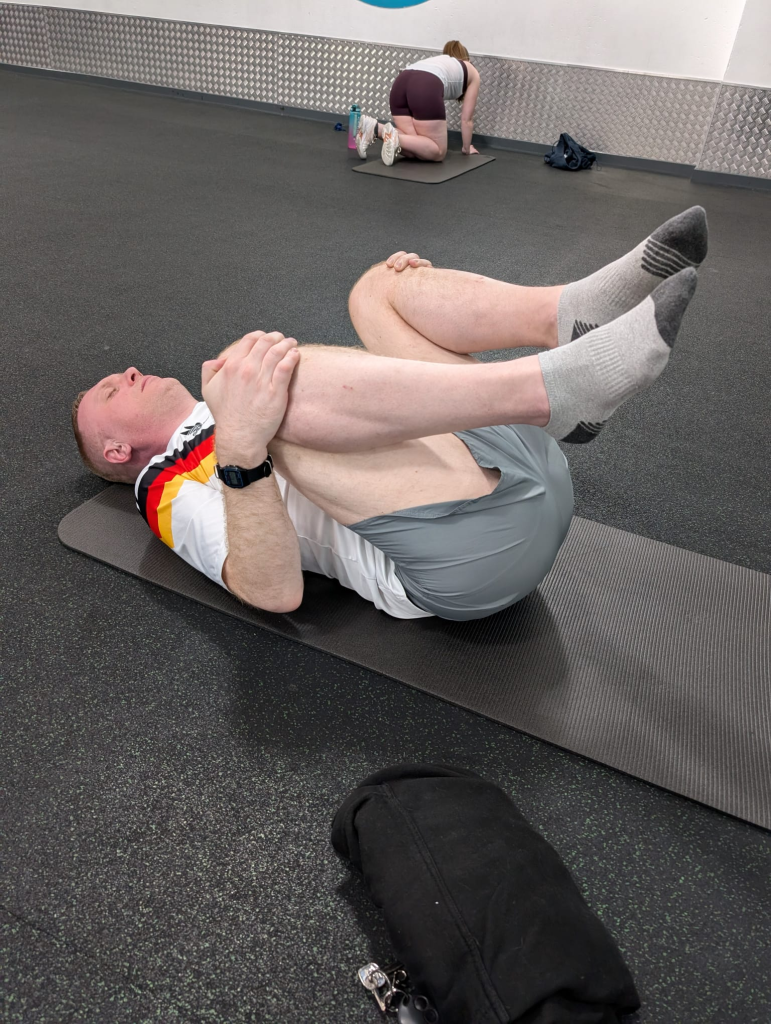
Drawing knees in again, easing tension from the lower back and massaging the back of the pelvis, spine and back into the mat. 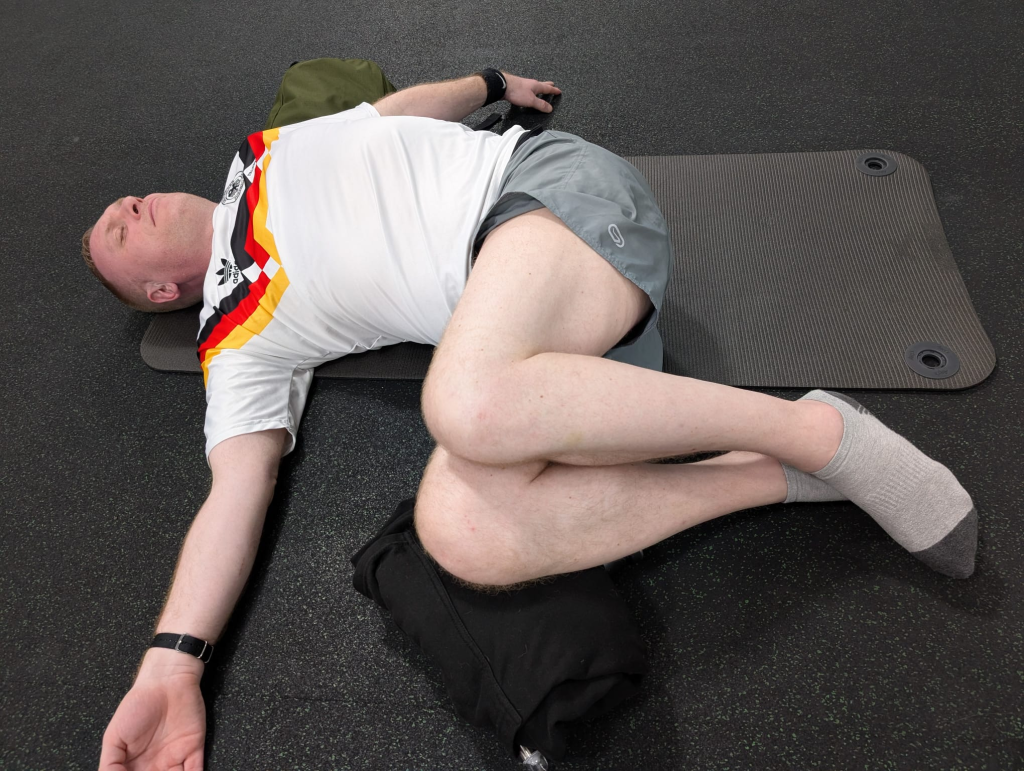
Supine twist. Gentle rotation, softening through the spine. 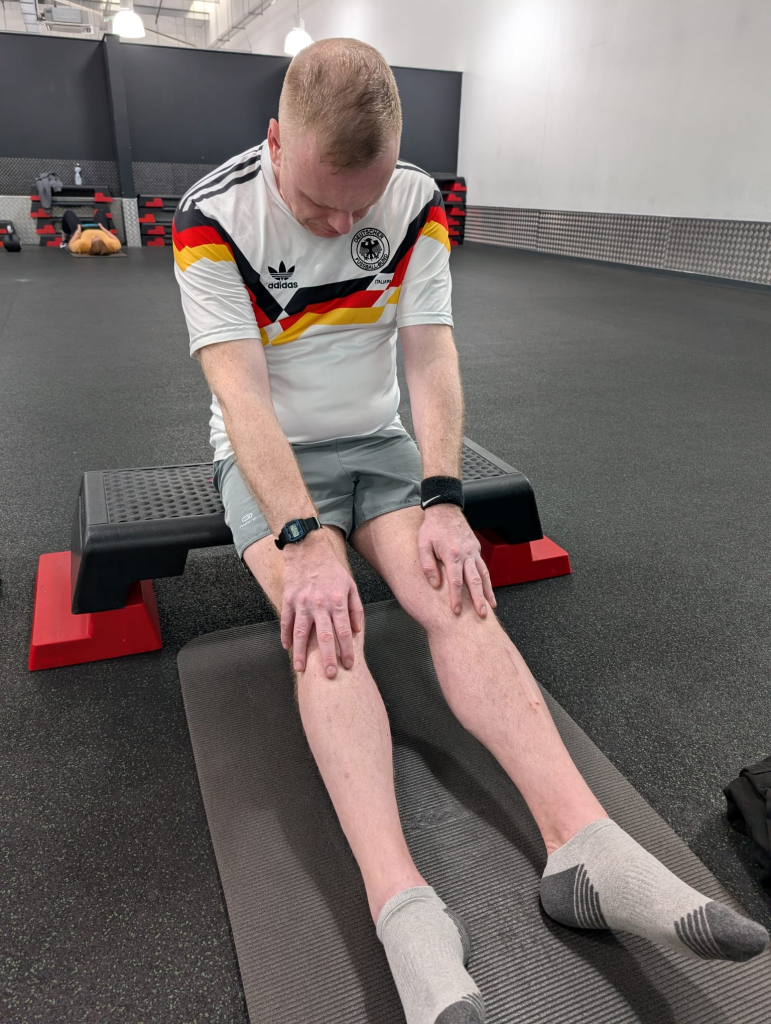
Caterpillar pose, using a step to raise my hips and meet the pose where I’m at. 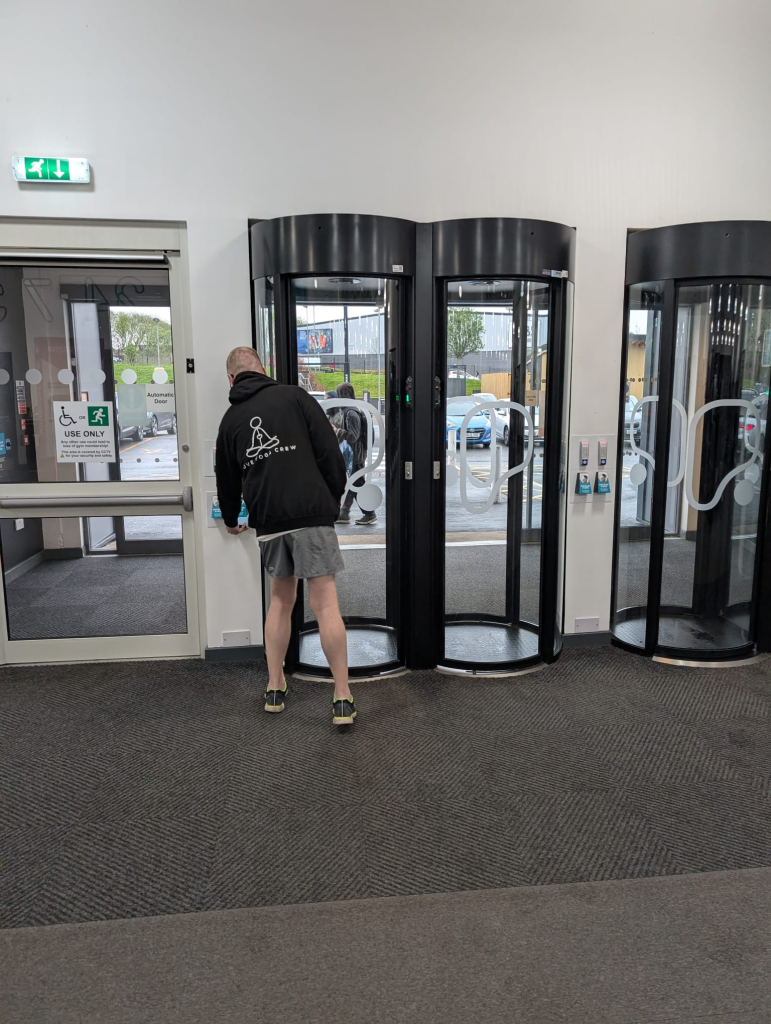
Walking out feeling lighter. Hoodie on, good work done. Now we’re home. Bit of housework, cuddles with Chipshop, pizza and beer lined up. A good session, and now a good rest.
-
Back on My Feet, Thanks to Stephanie
It’s taken a while, but I’m starting to feel like I’m coming back to myself again after the back injury. What made the biggest difference wasn’t the painkillers or the rest. It was a 1-to-1 yoga session with Stephanie.
Being in pain for that long messes with your head. It wasn’t just the physical discomfort, it was the frustration, the limits, the not knowing how long it would last. Simple things like walking, sleeping, or even sitting still became difficult. I started to feel a bit stuck, and honestly, a bit low.
Stephanie guided me through some gentle movement that actually felt doable. No pressure, no pretzel poses, just the kind of slow, thoughtful stuff that let me feel like I could trust my body again. We moved, we breathed, and I left that session feeling more mobile, more confident, and, most of all, more hopeful.
I’ve never really considered myself a “yoga person,” but that session shifted something for me. It wasn’t about being flexible or ticking off poses. It was about tuning in, listening, and doing something kind for my body at a time when kindness was exactly what it needed.
If you’re ever in a tough place physically or mentally, I honestly recommend checking out what she offers. Stephanie’s work at Love Yoga Crew isn’t just yoga. It’s care, compassion, and calm in action.
I’m really grateful for that moment. It reminded me that healing isn’t always about doing more. Sometimes it’s about doing less, but doing it with intention. And it helps when someone you trust is there to guide you.
-
Why I’m Here (and Not There)
There was a time when the internet felt quieter and friendlier. Before social media, before the constant noise, there were just websites and blogs. You’d find someone’s corner of the internet, read what they were thinking, maybe send them an email. It felt more human. And it felt like enough.
These days it’s different. Social media became the default. We stopped building our own spaces and started posting into systems we don’t control. It’s been getting to me for a while.
So I’m changing how I do things.
One of the first things I’ve done is rethink how people contact me. I’ve kept it simple. There’s a form on this site that works and sends messages directly to me. No layers, no logins, no unnecessary hassle.
I’m also trying to take myself off social media altogether. Quietly. I don’t need to be part of something that constantly demands attention. I’d rather have something slower and calmer.
This website is where I’ll try to build that. And the truth is, it can do most of what social media does. I can post a photo of my dinner here, just like I could on Instagram. I can write short thoughts or longer ones, like Twitter or Facebook. People can leave comments if they want to respond. I can still share things, reflect, and stay in touch; just without all the noise that usually comes with it.
The difference is, I control this space. No ads. No feeds. Just a small corner of the internet where I can show up as myself.
It might not be as fast or far-reaching. But I don’t mind that. I’d rather this space felt like a quiet room than a crowded feed.
Thanks for being here.